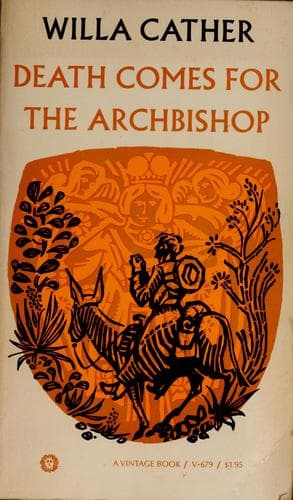
Christian fiction; Clergy -- Fiction; Historical fiction; New Mexico -- Fiction
The missionary came in, attended by a chamberlain who carried two great
black valises full of objects to be blessed--instead of one, as was
customary. After his reception, Father Joseph began to pour out such a
vivid account of his missions and brother missionaries, that both the
Holy Father and the secretary forgot to take account of time, and the
audience lasted three times as long as such interviews were supposed to
last. Gregory XVI, that aristocratic and autocratic prelate, who stood
so consistently on the wrong side in European politics, and was the
enemy of Free Italy, had done more than any of his predecessors to
propagate the Faith in remote parts of the world. And here was a
missionary after his own heart. Father Vaillant asked for blessings for
himself, his fellow priests, his missions, his Bishop. He opened his big
valises like pedlars' packs, full of crosses, rosaries, prayer-books,
medals, breviaries, on which he begged more than the usual blessing. The
astonished chamberlain had come and gone several times, and Mazzucchi at
last reminded the Holy Father that he had other engagements. Father
Vaillant caught up his two valises himself, the chamberlain not being
there at the moment, and thus laden, was bowing himself backward out of
the presence, when the Pope rose from his chair and lifted his hand, not
in benediction but in salutation, and called out to the departing
missionary, as one man to another, "_Coraggio, Americano_!"
Bishop Latour found his Navajo house favourable for reflection, for
recalling the past and planning the future. He wrote long letters to his
brother and to old friends in France. The hogan was isolated like a
ship's cabin on the ocean, with the murmuring of great winds about it.
There was no opening except the door, always open, and the air without
had the turbid yellow light of sand-storms. All day long the sand came
in through the cracks in the walls and formed little ridges on the earth
floor. It rattled like sleet upon the dead leaves of the tree-branch
roof. This house was so frail a shelter that one seemed to be sitting in
the heart of a world made of dusty earth and moving air.
4
EUSABIO
ON the third day of his visit with Eusabio, the Bishop wrote a somewhat
formal letter of recall to his Vicar, and then went for his daily walk
in the desert. He stayed out until sunset, when the wind fell and the
air cleared, to a crystal sharpness. As he was returning, still a mile
or more up the river, he heard the deep sound of a cottonwood drum,
beaten softly. He surmised that the sound came from Eusabio's house, and
that his friend was at home.
Public-domain text, read in full here on John Shaqi.
Reviews
Reviews
No reviews yet
Be the first to share your thoughts on this work.
Elsewhere in the archive
Join the Discussion
Join the discussion
Sign in to leave a comment or review.
Sign InorCreate an account