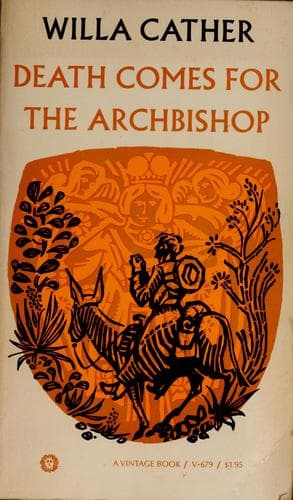
Christian fiction; Clergy -- Fiction; Historical fiction; New Mexico -- Fiction
The Bishop seldom lunched alone. That was the hour when he could most
conveniently entertain a priest from one of the distant parishes, an
army officer, an American trader, a visitor from Old Mexico or
California. He had no parlour--his dining-room served that purpose. It
was long and cool, with windows only at the west end, opening into the
garden. The green jalousies let in a tempered light. Sunbeams played on
the white, rounded walls and twinkled on the glass and silver of the
sideboard. When Madame Olivares left Santa Fé to return to New Orleans
and sold her effects at auction, Father Latour bought her sideboard, and
the dining-table around which friends had so often gathered. Doña
Isabella gave him her silver coffee service and candelabra for
remembrance. They were the only ornaments of the severe and shadowy
room.
The Bishop was already at his place when Father Joseph entered.
"Fructosa has told you why we are lunching early? We will take a ride
this afternoon. I have something to show you."
"Very good. Perhaps you have noticed that I am a little restless. I
don't know when I have been two weeks out of the saddle before. When I
go to visit Contento in his stall, he looks at me reprovingly. He will
grow too fat."
The Bishop smiled, with a shade of sarcasm on his upper lip. He knew his
Joseph. "Ah, well," he said carelessly, "a little rest will not hurt
him, after coming six hundred miles from Tucson. You can take him out
this afternoon, and I will ride Angelica."
The two priests left Santa Fé a little after midday, riding west. The
Bishop did not disclose his objective, and the Vicar asked no questions.
Soon they left the wagon road and took a trail running straight south,
through an empty greasewood country sloping gradually in the direction
of the naked, blue Sandia mountains.
At about four o'clock they came out upon a ridge high over the Rio
Grande valley. The trail dropped down a long decline at this point and
wound about the foot of the Sandias into Albuquerque, some sixty miles
away. This ridge was covered with cone-shaped, rocky hills, thinly clad
with piñons, and the rock was a curious shade of green, something
between sea-green and olive. The thin, pebbly earth, which was merely
the rock pulverized by weather, had the same green tint. Father Latour
rode to an isolated hill that beetled over the western edge of the
ridge, just where the trail descended. This hill stood up high and quite
alone, boldly facing the declining sun and the blue Sandias. As they
drew close to it, Father Vaillant noticed that on the western face the
earth had been scooped away, exposing a rugged wall of rock--not green
like the surrounding hills, but yellow, a strong golden ochre, very much
like the gold of the sunlight that was now beating upon it. Picks and
crowbars lay about, and fragments of stone, freshly broken off.
Public-domain text, read in full here on John Shaqi.
Reviews
Reviews
No reviews yet
Be the first to share your thoughts on this work.
Elsewhere in the archive
Join the Discussion
Join the discussion
Sign in to leave a comment or review.
Sign InorCreate an account