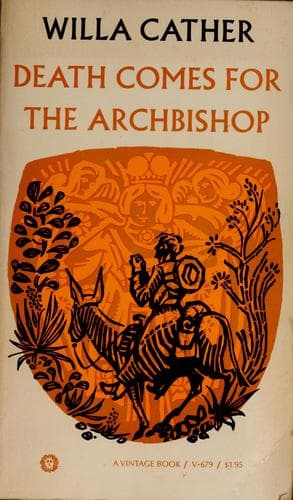
Christian fiction; Clergy -- Fiction; Historical fiction; New Mexico -- Fiction
Eusabio did not stay long, but he said he would come again to-morrow, as
he had business in Santa Fé that would keep him for some days. He had
no business there; but when he looked at Father Latour he said to
himself, "It will not be long."
After he was gone, the Bishop turned to Bernard; "My son, I have lived
to see two great wrongs righted; I have seen the end of black slavery,
and I have seen the Navajos restored to their own country."
For many years Father Latour used to wonder if there would ever be an
end to the Indian wars while there was one Navajo or Apache left alive.
Too many traders and manufacturers made a rich profit out of that
warfare; a political machine and immense capital were employed to keep
it going.
7
THE Bishop's middle years in New Mexico had been clouded by the
persecution of the Navajos and their expulsion from their own country.
Through his friendship with Eusabio he had become interested in the
Navajos soon after he first came to his new diocese, and he admired
them; they stirred his imagination. Though this nomad people were much
slower to adopt white man's ways than the homestaying Indians who dwelt
in pueblos, and were much more indifferent to missionaries and the white
man's religion, Father Latour felt a superior strength in them. There
was purpose and conviction behind their inscrutable reserve; something
active and quick, something with an edge. The expulsion of the Navajos
from their country, which had been theirs no man knew how long, had
seemed to him an injustice that cried to Heaven. Never could he forget
that terrible winter when they were being hunted down and driven by
thousands from their own reservation to the Bosque Redondo, three
hundred miles away on the Pecos River. Hundreds of them, men, women, and
children, perished from hunger and cold on the way; their sheep and
horses died from exhaustion crossing the mountains. None ever went
willingly; they were driven by starvation and the bayonet; captured in
isolated bands, and brutally deported.
It was his own misguided friend, Kit Carson, who finally subdued the
last unconquered remnant of that people; who followed them into the
depths of the Canyon de Chelly, whither they had fled from their grazing
plains and pine forests to make their last stand. They were shepherds,
with no property but their live-stock, encumbered by their women and
children, poorly armed and with scanty ammunition. But this canyon had
always before proved impenetrable to white troops. The Navajos believed
it could not be taken. They believed that their old gods dwelt in the
fastnesses of that canyon; like their Shiprock, it was an inviolate
place, the very heart and centre of their life.
Public-domain text, read in full here on John Shaqi.
Reviews
Reviews
No reviews yet
Be the first to share your thoughts on this work.
Elsewhere in the archive
Join the Discussion
Join the discussion
Sign in to leave a comment or review.
Sign InorCreate an account