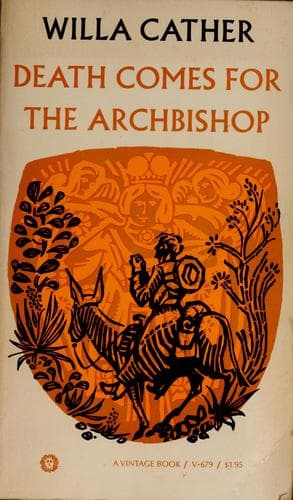
Christian fiction; Clergy -- Fiction; Historical fiction; New Mexico -- Fiction
When the Bishop, unable to compose their differences, supported the new
priest, Father Martinez and his friend Father Lucero, of Arroyo Hondo,
mutinied; flatly refused to submit, and organized a church of their own.
This, they declared, was the old Holy Catholic Church of Mexico, while
the Bishop's church was an American institution. In both towns the
greater part of the population went over to the schismatic church,
though some pious Mexicans, in great perplexity, attended Mass at both.
Father Martinez printed a long and eloquent Proclamation (which very few
of his parishioners could read) giving an historical justification for
his schism, and denying the obligation of celibacy for the priesthood.
As both he and Father Lucero were well on in years, this particular
clause could be of little benefit to anyone in their new organization
except Trinidad. After the two old priests went off into schism, one of
their first solemn acts was to elevate Father Lucero's nephew to the
priesthood, and he acted as curate to them both, swinging back and forth
between Taos and Arroyo Hondo.
The schismatic church at least accomplished the rejuvenation of the two
rebellious priests at its head, and far and wide revived men's interest
in them,--though they had always furnished their people with plenty to
talk about. Ever since they were young men with adjoining parishes, they
had been friends, cronies, rivals, sometimes bitter enemies. But their
quarrels could never keep them apart for long.
Old Marino Lucero had not one trait in common with Martinez, except the
love of authority. He had been a miser from his youth, and lived down in
the sunken world of Arroyo Hondo in the barest poverty, though he was
supposed to be very rich. He used to boast that his house was as poor as
a burro's stable. His bed, his crucifix, and his bean-pot were his
furniture. He kept no live-stock but one poor mule, on which he rode
over to Taos to quarrel with his friend Martinez, or to get a solid
dinner when he was hungry. In his _casa_ every day was Friday--unless
one of his neighbour women cooked a chicken and brought it in to him out
of pure compassion. For his people liked him. He was grasping, but not
oppressive, and he wrung more pesos out of Arroyo Seco and Questa than
out of his own arroyo. Thrift is such a rare quality among Mexicans that
they find it very amusing; his people loved to tell how he never bought
anything, but picked up old brooms after housewives had thrown them
away, and that he wore Padre Martinez's garments after the Padre would
have them no longer, though they were so much too big for him. One of
the priests' fiercest quarrels had come about because Martinez gave some
of his old clothes to a monk from Mexico who was studying at his house,
and who had not wherewithal to cover himself as winter came on.
The two priests had always talked shamelessly about each other. All
Martinez's best stories were about Lucero, and all Lucero's were about
Martinez.
Public-domain text, read in full here on John Shaqi.
Reviews
Reviews
No reviews yet
Be the first to share your thoughts on this work.
Elsewhere in the archive
Join the Discussion
Join the discussion
Sign in to leave a comment or review.
Sign InorCreate an account