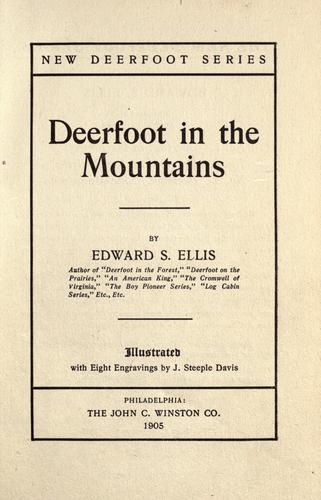
Overland journeys to the Pacific -- Juvenile fiction; Shawnee Indians -- Juvenile fiction; Siksika Indians -- Juvenile fiction
The most trying difficulty was that of crossing streams, which were
more numerous than they had supposed. Some were mountain torrents of
only a few yards width, others deserved the name of rivers, and the
current of each was of icy coldness. More than once they saw blocks of
ice grinding and tumbling over one another as they plunged rapidly
onward. It was so dangerous at times for the horses to attempt to swim
across, and so hard and disagreeable for the youths, that hours were
spent in hunting for a fording place. Fortunately they were always able
to gather enough fuel to make themselves comfortable at night; grass
became more plentiful and no trouble was had in procuring game. This
generally consisted of bison, but it was a great improvement when they
were able to bring down a Rocky Mountain sheep. This animal does not
bear wool, but hair like that of the deer, and is larger than the
largest domestic sheep. The horns of the males attain great size,
starting from just above the eyes, though not touching at the bases,
and curving over so as to include all the space between the ears. The
meat at certain seasons is very palatable and held in high favor. The
animal is generally known by the name of the "big horn," and is so
skilful a climber and so alert that it is quite a feat for a hunter to
bring down a specimen. Deerfoot was the only one on this return journey
who was able to bag the game, which never failed to elude George and
Victor Shelton.
CHAPTER XXII.
A MEMORABLE MEETING.
If you will examine the map of the State of Montana you will note that
the central county bears the name of Fergus, while one of the counties
lying directly south is Yellowstone. The boundary between these two is
the Musselshell River, which, flowing directly northward, separates
Custer and Dawson counties, joining the Missouri at the northeastern
corner of Fergus County. It was in the latter part of May, 1805, that
Deerfoot and the two Shelton boys, after a long, wearisome ride and
tramp through a wild and unknown region, broken by mountain spurs and
crossed by numberless streams, arrived at the mouth of the Musselshell.
Even with summer hardly a fortnight off, ice formed at night, flurries
of snow filled the air at times and the camp fire became a necessity.
And yet our friends were plagued by mosquitoes, grass was plentiful,
and there was no lack of game. The party seemed to be sharing the
summer and winter seasons, with the most disagreeable features of both.
Having followed the Missouri so far, Deerfoot said that a crossing
place must be found before the morrow, for it was inevitable that the
farther they went down stream the larger it would become, because of
its numerous tributaries. The Missouri was an eighth of a mile across
at its junction with the Musselshell, but its current was gentle. Not
an Indian had been seen for four days, and Deerfoot was on foot
searching the northern shore for a good crossing place when George
Shelton called out:
Public-domain text, read in full here on John Shaqi.
Reviews
Reviews
No reviews yet
Be the first to share your thoughts on this work.
Elsewhere in the archive
Join the Discussion
Join the discussion
Sign in to leave a comment or review.
Sign InorCreate an account