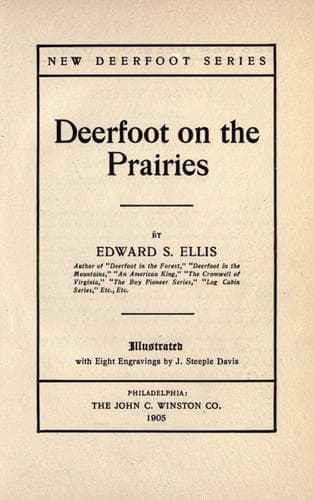
Frontier and pioneer life -- Juvenile fiction; Shawnee Indians -- Juvenile fiction
Immortality is not capable of scientific proof, but one of the strongest
evidences of its truth is that yearning which is implanted, to a greater
or less degree, in every human heart, and in every race, no matter how
low or degraded its order in the rank of civilization. All religions,
whether true or false, are based on the idea of a life beyond the grave.
It accords with reason and with the self-evident fact that no man can
feel that his life’s work is rounded out and completed on earth, and
that consequently there must be another existence in which that work
shall be carried on.
That these longings, these yearnings, this instinctive reaching out for
the things beyond mortal grasp, are an inherent part of our being show
that they have been divinely planted there by One who is capable of
satisfying them all, and who, in his own good time, will satisfy them.
So reasonable and so well founded is this belief that the burden of
proof is thrown upon those who dispute it. Let them demonstrate, if they
can, that that which we call death ends all. But it is beyond their
power, and from the nature of things always will be beyond their power,
to do this impossible thing.
At the opening of this century we stand on the threshold of the most
marvelous discoveries and achievements made since the world began. Some
of these discoveries fill us with awe, and clearly presage the greater
that are close at hand. Among them may be the scientific proof of a
future existence, though such proof is not necessary with the most
exalted intellects, any more than it is with the simpler and more
child-like minds.
We must not wander, however, from the thread of our narrative, though
the subject is the most momentous that can engage our mental powers.
When Mul-tal-la put into more definite form the dim glimpses that his
countrymen had caught of the true light, he appealed to Deerfoot, who in
his modest, convincing manner told the story of his conversion and of
the sweet communion he held every day with the Father of All Good. It
was a faith which no trial, no suffering, no torture could change or
modify, and he impressed upon his absorbed listeners the ineffable
beauties of the religion which made a man a new being and fitted him for
the life to come.
Public-domain text, read in full here on John Shaqi.
Reviews
Reviews
No reviews yet
Be the first to share your thoughts on this work.
Elsewhere in the archive
Join the Discussion
Join the discussion
Sign in to leave a comment or review.
Sign InorCreate an account