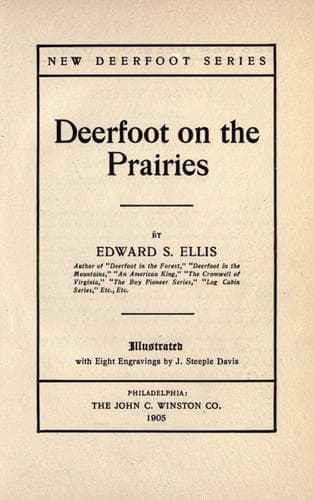
Frontier and pioneer life -- Juvenile fiction; Shawnee Indians -- Juvenile fiction
But the choice lay between that and the labor of carrying the boat over
the towering rock at the expense of great time and labor. Neither
Deerfoot nor Mul-tal-la hesitated, and George and Victor braced
themselves for the struggle. It proved to be hair-raising. Gripping the
sides of the canoe, the boys often held their breath and crouched ready
for a leap and swim for life, but the coolness and skill of the two
Indians never faltered. Without speaking a word, each understood on the
instant the right thing to do, and did it. Repeatedly the craft touched
some of the jagged dripping points of rock, and an inch or two more to
the right or left would have brought quick destruction to the frail
craft, but that slight distance was never passed and they sped onward
like a race horse. A vicious wave would fling the boat almost out of the
water, and then a foaming breaker seemed about to seize it in its
remorseless grasp. A moment later a whirlpool or eddy would have spun
the canoe around like a top but for the powerful sweep of those two
paddles, which worked like the spokes of the same wheel.
When the lads began to breathe more freely they would gasp and make
ready to spring into the water, for disaster seemed rushing upon them,
but the swarthy, muscular forms never wavered nor lost control. George
and Victor had been with Deerfoot in many situations of peril, but they
were sure he never displayed such skill as when guiding the craft
through these rapids. Being at the front, his hand was the master one,
but, as I have said, it was as if the same impulse guided the arms of
Shawanoe and Blackfoot.
This wild charge lasted for half a mile, when the river expanded to a
width of two hundred yards; but before the brothers could find much
comfort in the fact the situation suddenly became more trying than ever.
The channel was divided by two rocky islands, the lower and larger being
in the middle of the river. Few Indians dared risk a passage past these
obstructions, but the Shawanoe and Blackfoot took it without a moment’s
hesitation, and, shipping a little water, sped through without mishap.
Turning into a deep bend of the river on the right the explorers went
into camp for the night.
A short distance below was a village of some twenty houses, in which
lived a tribe of Indians called Echeloots, who belong to the Upper
Chinooks. They were hospitable to the visitors, who noted several
interesting peculiarities in them, of whom only a very few survivors now
exist. For the first time in their travels among the Indians our friends
saw wooden houses. They were rude structures, whose chimneys consisted
of a single hole each, with a small door at the gable end, which was
partly underground.
Public-domain text, read in full here on John Shaqi.
Reviews
Reviews
No reviews yet
Be the first to share your thoughts on this work.
Elsewhere in the archive
Join the Discussion
Join the discussion
Sign in to leave a comment or review.
Sign InorCreate an account