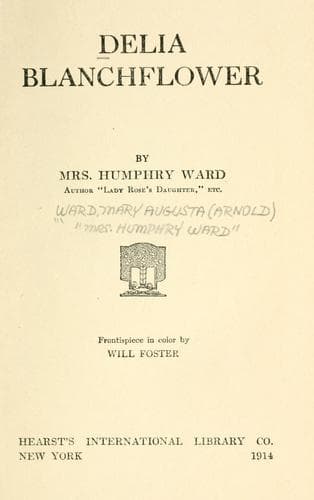
Guardian and ward -- Fiction; Women -- Suffrage -- Great Britain -- Fiction; Young women -- Fiction
Meanwhile Delia, with a red spot of agitation on either cheek, was
sitting at the old satin-wood bureau in the drawing-room, writing a
cheque. A knock at the door disturbed her. She half rose, to see
Wilmington open and close it.
A look at his face startled her. She sank back into her chair, in
evident confusion. But her troubled eyes met his appealingly.
Wilmington's disturbance was plain.
"I had ventured to think--to hope--" he began, abruptly--"that although
you refused to give me your promise when I asked it, yet that you would
not again--or so soon again--receive Mr. Lathrop--privately."
Delia rose and came towards him.
"I told Lady Tonbridge not to come down. Was that very wrong of me?"
She looked at him, half smiling, half hanging her head.
"It was unwise--and, I think, unkind!" said Winnington, with energy.
"Unkind to you?" She lifted her beautiful eyes. There was something
touching in their strained expression, and in her tone.
"Unkind to yourself, first of all," he said, firmly. "I must repeat
Miss Delia, that this man is not a fit associate for you or any young
girl. You do yourself harm by admitting him--by allowing him to see you
alone--and you hurt your friends."
Delia paused a moment.
"Then you don't trust me at all?" she said at last, slowly.
Winnington melted. How pale she looked! He came forward and took her
hand--
"Of course I trust you! But you don't know--you are too young. You
confess you have some business with Mr. Lathrop that you can't tell
me--your guardian; and you have no idea to what misrepresentations you
expose yourself, or with what kind of a man you have to deal!"
Delia withdrew her hand, and dropped into a chair--her eyes on the
carpet.
"I meant--" she said, and her tone trembled--"I did mean to have told
you everything to-day."
"And now--now you can't?"
She made no reply, and in the silence he watched her closely. What
could account for such an eclipse of all her young vivacity? It was
clear to him that that fellow was entangling her in some monstrous
way--part and parcel no doubt of this militant propaganda--and
calculating on developments. Winnington's blood boiled. But while he
stood uncertain, Delia rose, went to the bureau where she had been
writing, brought thence a cheque, and mutely offered it.
"What is this?" he asked.
"The money you lent me."
And to his astonishment he saw that the cheque was for L500, and was
signed "Delia Blanchflower."
"You will of course explain?" he said, looking at her keenly. Suddenly
Delia's embarrassed smile broke through.
"It's--it's only that I've been trying to pay my debts!"
His patience gave way.
"I'm afraid I must tell you--very plainly--that unless you can account
to me for this cheque, I must entirely refuse to take it!"
Delia put her hands behind her, like a scolded child.
"It is my very own," she protested, mildly. "I had some ugly jewels
that my grandmother left me, and I have sold them--that's all."
Winnington's grey eyes held her.
Public-domain text, read in full here on John Shaqi.
Reviews
Reviews
No reviews yet
Be the first to share your thoughts on this work.
Elsewhere in the archive
Join the Discussion
Join the discussion
Sign in to leave a comment or review.
Sign InorCreate an account