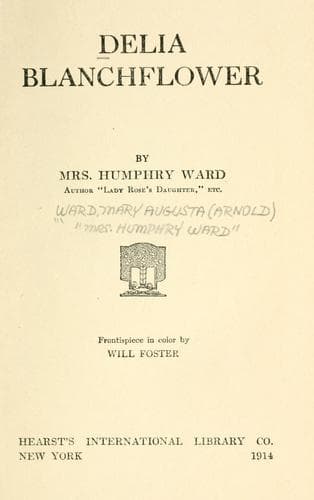
Guardian and ward -- Fiction; Women -- Suffrage -- Great Britain -- Fiction; Young women -- Fiction
Tension broke up in slightly hysterical laughter. She was already in
better spirits. There was something exciting--exhilarating even--in
the duel between herself and Winnington, which was implied in the
conversation. His journey up to town, the look in his grey eyes
meant--"I shall prevent you from doing what you are intending to do."
But he could not prevent it. If he was the breakwater, she was the
storm-wave, driven by the gale--by the wind from afar, of which she
felt herself the sport, and sometimes the victim--without its changing
her purpose in the least.
"Only I shall not refuse food!" she thought. "I shall spare him that. I
shall serve my sentence. It won't be long."
But afterwards? Would she then be free? Free to follow Gertrude or not,
according to her judgment? Would she have "purged" her promise--paid
her shot--recovered the governance of herself?
Her thoughts discussed the future, when, all in a moment, Winnington,
watching her from behind his _Times_, saw a pale startled look. It
seemed to be caused by something in the landscape. He turned his eyes
to the window and saw that they were passing an old manor house, with a
gabled front, standing above the line, among trees. What could that
have had to do with the sudden contraction of the beautiful brow, the
sudden look of terror--or distress? The house had a certain resemblance
to Monk Lawrence. Had it reminded her of that speech in the Latchford
marketplace from which he was certain she had recoiled, no less than
he?
"You'll let me take you to the flat? I've been over it once, but I
should like to see it's in order."
She hesitated, but how could she refuse? He put her into a taxi, having
already dispatched her maid with the luggage in another, and they
started.
"I expect you'll find a lot of queer people there!" she said, trying to
laugh. "At least you'll think them queer."
"I shall like to see the people you are working with," he said,
gravely.
Half way to Westminster, he turned to her.
"Miss Delia!--it's my plain duty to tell you--again--and to keep on
telling you, even though it makes you angry, and even though I have no
power to stop you, that in taking part in these doings to-morrow, you
are doing a wrong thing, a grievously wrong thing! If I were only an
ordinary friend, I should try to dissuade you with all my might. But I
represent your father--and you know what he would have felt."
He saw her lips tremble. But she spoke calmly, "Yes,--I know. But it
can't be helped. We can't agree, Mr. Mark, and it's no good my trying
to explain, any more--just yet!--" she added, in a lower tone.
"'Just yet'? What do you mean by that?"
Public-domain text, read in full here on John Shaqi.
Reviews
Reviews
No reviews yet
Be the first to share your thoughts on this work.
Elsewhere in the archive
Join the Discussion
Join the discussion
Sign in to leave a comment or review.
Sign InorCreate an account