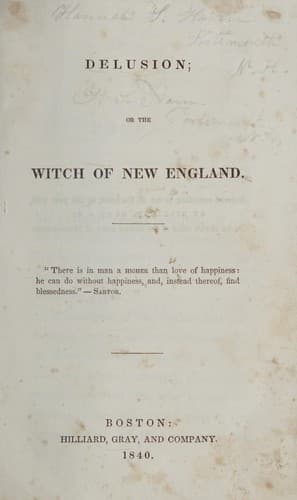
Delusion; or, The Witch of New England — John Shaqi
Delusion; or, The Witch of New EnglandLee, Eliza Buckminster
History
Delusion; or, The Witch of New England
Lee, Eliza Buckminster
Paranormal fiction; Salem (Mass.) -- History -- Colonial period, ca. 1600-1775 -- Fiction; Witchcraft -- New England -- Fiction
And now that I have finished my sermon, let me scold you for
wronging yourself, as you too often do. _Truth_ is not to be set
aside, in looking at our own characters. We should do the same
justice to ourselves that we do to others. There is a secret
dishonesty in depreciating ourselves. Could I esteem and honor you
as I do, were you what you call yourself? I honor you for all the
noble exertions you have made,--for the ardor of your love of truth
and duty. Ah, call me not a partial and blinded judge: your true
honor and your most precious happiness are too dear to me to allow
me to be a false or partial friend. I would give you a little, a
very little vanity; not enough to make you a sumptuous robe, but
just enough to keep you from the cold.
You say you look upon this delusion of witchcraft, that is
spreading through the country, with fearful and trembling interest,
and that you believe God may permit his will to be made known by
such instruments as these. God forbid that I should limit his
power! but I fear these poor children are wicked or diseased, and
that Satan has nothing to do with it.
The old woman at the cliff is now very ill: I trust God will take
her from the world before she is seized for a witch. There are many
ready to believe that she has ridden through the air on a
broomstick, or gone to sea in an egg-shell. But you do not love me
to jest on this subject. Forgive me! I will not jest again.
And this balmy Indian summer,--it seems as if it would last
forever. But I am so happy now, I can hardly believe there is
sorrow in the world, or winter in the year. Winter has no terror
now: the long evenings and nights bring me dreams of you, and I
awake with the consciousness that you are mine. * * *
Perhaps the reader may think the letter just read a very singular
love-letter. But it must be remembered that religion was the
all-absorbing sentiment of the Puritans, and that Seymore's enthusiastic
temperament made it the subject that most interested him in his letters
to Edith.
Edith's mind was too well balanced and too happily constituted to allow
her to partake of his extravagance; but she gave him that dearest proof
of love, that of softening all his defects, and even exalting them into
the most precious virtues.
CHAPTER XIII.
"Apart she lived, and still she rests alone:
Yon earthly heap awaits no flattering stone."
As it was mentioned in Edith's letter, the old woman who lived at the
cottage by the cliff had become very ill, and it was apparent that she
would never leave her bed again. Edith had been assiduous in her
kindness. Dinah had been with her a part of every day, and had watched
with her many nights. Edith insisted, at last, that her poor slave
should sleep, and resolved herself to take her place by the bedside.
Public-domain text, read in full here on John Shaqi.
Reviews
Reviews
No reviews yet
Be the first to share your thoughts on this work.
Join the Discussion
Join the discussion
Sign in to leave a comment or review.
Sign InorCreate an account