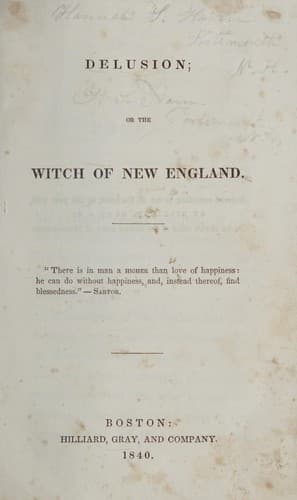
Delusion; or, The Witch of New EnglandLee, Eliza Buckminster
History
Delusion; or, The Witch of New England
Lee, Eliza Buckminster
Paranormal fiction; Salem (Mass.) -- History -- Colonial period, ca. 1600-1775 -- Fiction; Witchcraft -- New England -- Fiction
The old woman had made herself feared and hated by the scattered
inhabitants. She was called a witch, and they deserted her sick bed,--a
thing most rare among the kind-hearted dwellers in a thinly-peopled
neighborhood.
It was a threatening evening when Edith took her station by the low
pallet of the sick woman. The solitary hut, as I have mentioned, stood
on the edge of the little bay; and, at high water, it was almost washed
by the waves.
How different the whole scene from that brilliant morning when Edith
visited the tenant of the cottage! A leaden cloud seemed now to rest on
the water, shutting out the fair sky; and, as the sullen waves rolled on
the beach, a close and stifling air oppressed Edith's spirits.
The old woman was alone: her poor grandchild, wearied with the services
of the day, had fallen asleep with her hand in her grandmother's, and
her head falling over the pillow: her long hair rested on the old
woman's face, which she seemed not to have strength to remove.
Edith's first care was to take the little girl from her grandmother's
pillow; and, laying her gently on the foot of the bed, she took off her
own shawl, and made a pillow for her head. The old woman looked at her
without speaking, and a tear coursed slowly down her cheek.
Edith hoped the hardness was melting from her heart. She took her hand
tenderly in hers, and whispered, "Cannot you put your trust in God?"
"I cannot pray--to God; no, it is too late. But"--and her voice was
interrupted with short, impeded breath. She pointed to the child, and
looked at Edith with an expression so imploring, so full of tenderness
for the child, of agony that she must leave her, of appeal to Edith's
compassion, that the tears started to her eyes, and she answered, "Fear
nothing: I will take care of her; I will be a mother to her."
The old woman pressed her hand: the look of agony passed away from her
features, and she closed her eyes to sleep.
Edith sat silently by the bedside. The tempest that had been gathering
over the water now shook the little dwelling: torrents of rain fell, and
frequent flashes lighted the little room. At last, a gust of wind from
the broken window extinguished the taper, and Edith was in total
darkness. It was a warm night for the season, and no fire on the hearth
to afford a spark by which she could relight it.
Edith trembled; but she tried to be calm. She only feared the old woman
would die while she held her hand, which she imagined was already
growing cold in hers.
The storm gradually passed away into silence. There was no sound but the
short, interrupted breath of her patient, and the soft, healthful,
regular breathing of infancy. Edith longed for the dawn, and looked
anxiously through the little casement for the first gray streak. As far
as the eye could reach, the bay was white with foam; but no light yet
dawned upon it from the morning.
The old woman awoke. "I cannot see you," she said; "a film is over my
eyes."
Public-domain text, read in full here on John Shaqi.
Reviews
Reviews
No reviews yet
Be the first to share your thoughts on this work.
Join the Discussion
Join the discussion
Sign in to leave a comment or review.
Sign InorCreate an account