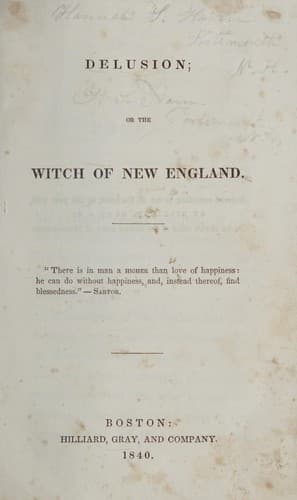
Delusion; or, The Witch of New EnglandLee, Eliza Buckminster
History
Delusion; or, The Witch of New England
Lee, Eliza Buckminster
Paranormal fiction; Salem (Mass.) -- History -- Colonial period, ca. 1600-1775 -- Fiction; Witchcraft -- New England -- Fiction
she could not always be insensible to the beauty of the heaven that had
so often canopied her sleep, or the grandeur of the ocean where she had
passed whole days playing with the waves. She rebelled against the
restraint that every feminine occupation imposed on this wild liberty.
She quailed, indeed, before Dinah's more resolute spirit; but Edith's
gentleness had failed to touch her heart; and she knew that her forced
obedience to Dinah was only the result of Edith's authority.
When the child appeared, Edith held out her hand with her own grave,
sweet smile; but, the moment the child saw her, she began again to act
her part, and to throw her body and limbs into violent contortions.
Edith was not alarmed: she saw it was feigned; and, drawing her to her
knees, she held both her little hands tightly clasped in hers. Phoebe
became instantly calm; but this was a part of the system of
deception,--that, as soon as the accused touched the afflicted, they
should be calmed and healed.
Edith looked in her face, and said, very kindly, "Tell me, my poor
child, who has persuaded you to do this wicked thing,--to accuse me of
this horrible crime? tell me truly. I shall not be angry with you, I
shall not punish you, if you tell me the truth. Who first spoke to you
about it? What have they promised you for bringing this trouble on me?"
The child, unmoved, said, "You yourself made me do it."
"I! O, my poor Phoebe, how can you be so wicked as to tell this dreadful
lie? Do you not know that God sees you and hears you, and that he will
punish you for it? I may die: you may cause my death; but you will live
to repent; and, O, how sorry you will be in after years, when you think
how much I loved you, and you have caused my death! But, my poor Phoebe,
you know not what you do; you know not what death is."
"My grandmother died," said the child.
"Ah, yes; but she died quietly in her bed, and you were sleeping near;
and when I took you in my arms to look at her, you saw only her peaceful
countenance. But I shall not die thus: I shall be dragged before angry
men, and, with irons on my hands and ankles, I shall be lifted to the
scaffold, and there, before hundreds of angry faces turned towards me,
I shall die alone! not peacefully, as your grandmother did, when with my
own hands I closed her eyes, but horribly, in pain and agony! and you
will have done this,--you that I have loved so"--
Phoebe became very red, and the tears came to her eyes.
Edith thought she had touched the child's heart, and continued: "I knew
you could not be so wicked, so young and looking so innocent. No, my
child; you love me, and you will unsay all you have said, and we will go
home again together."
The child answered, with much violence, "No, no, never! you pricked me
with pins, and you tormented me."
Public-domain text, read in full here on John Shaqi.
Reviews
Reviews
No reviews yet
Be the first to share your thoughts on this work.
Elsewhere in the archive
Join the Discussion
Join the discussion
Sign in to leave a comment or review.
Sign InorCreate an account