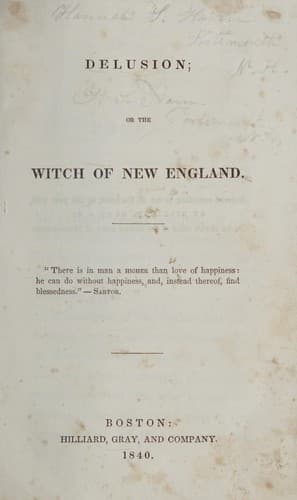
Delusion; or, The Witch of New EnglandLee, Eliza Buckminster
History
Delusion; or, The Witch of New England
Lee, Eliza Buckminster
Paranormal fiction; Salem (Mass.) -- History -- Colonial period, ca. 1600-1775 -- Fiction; Witchcraft -- New England -- Fiction
"And is her word to be taken against the testimony of my whole life? You
know how I have lived among you from my infancy."
"Yes; but God may choose the fairest of his works as instruments of his
sovereign will."
"Have you forgotten my father?" said Edith,--"how he lived among you? He
was ever your friend--always near you in every trouble. And myself"--she
stopped; for she would not remind them of her deeds of kindness,--of the
daily beauty of her life in their humble circle; nor would she recall
her orphanhood, her unprotected state; but she looked down, and her eyes
filled with tears. "God," she said, at length, "is the protection of the
orphan; and he will avenge this great sin, and you will answer for it at
his bar."
The deacon looked sternly decided and unmoved, but he began to urge her
to confess,--to do as others had done, and save her life by
acknowledging the crime.
Indignation kindled in Edith's eye; but she checked it, and said, "I
cannot, I durst not, belie my own soul, and commit so great a sin. God,
who is the searcher of my heart and your heart, as we shall both answer
at the judgment day, is witness that I know nothing of witchcraft,--of
no temptation of the evil one. I have felt, indeed--as who has not?--the
temptations that arise from our own passions; but I know no other, and
can confess no other."
She then desired that Phoebe might be brought to her, and Dinah
permitted to attend her in her prison. They consented that Edith should
see the child in the presence of one witness; and the mild old man who
was with the deacon said he would bring her himself.
CHAPTER XVI.
"I am constrained to declare, as the result of as thorough a
scrutiny as I could institute, my belief that this dreadful
transaction was introduced and driven on by wicked perjury and
wilful malice."
UPHAM'S LECTURE OX SALEM WITCHCRAFT.
"Is there any cause in nature that makes these hard hearts?"
LEAR.
There seems sometimes to be an element of evil in the heart of a child,
that would almost persuade us to believe in original sin. In the breast
of those who have been favorably born and kindly nurtured, it may sleep
forever; but, when the conscience has been soiled in early childhood, it
awakes the appetite for sin, and the restraint that comes afterwards
curbs without subduing the disposition to evil.
It is true that poor Phoebe had felt a strong affection for her
grandmother; and, without all other moral restraint, it was the only
point in which her heart could be touched. The vagrant life she had led
had also had its influence:
"Happy because the sunshine was her dower,"
Public-domain text, read in full here on John Shaqi.
Reviews
Reviews
No reviews yet
Be the first to share your thoughts on this work.
Elsewhere in the archive
Join the Discussion
Join the discussion
Sign in to leave a comment or review.
Sign InorCreate an account