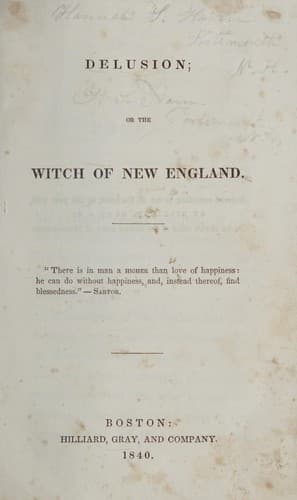
Delusion; or, The Witch of New EnglandLee, Eliza Buckminster
History
Delusion; or, The Witch of New England
Lee, Eliza Buckminster
Paranormal fiction; Salem (Mass.) -- History -- Colonial period, ca. 1600-1775 -- Fiction; Witchcraft -- New England -- Fiction
Dinah drooped again. "You could not do that," she said; "no, you could
not dishonor yourself with a falsehood: but if you could escape without
violating your conscience, would you not?"
"Certainly," answered Edith: "if God were to place the means of escape
within my reach, I would make use of them, as I would use the means to
recover from a fever. I should violate no law, for the proceedings
against me were unjust, and the testimony false. I could not yield to
Seymore's desire that I should escape, because his was one of the voices
that condemned me, and he could open my prison door, if at all, only by
an open and honorable confession of his error."
Dinah trembled with joy at hearing Edith speak thus of her willingness
to escape, could it be effected with truth; but she would not hint at
her hopes till she had arranged her plan with the assistance of Paul.
After a pause, Edith said, "Alas, there is no hope of escape: and why do
you fold my hair so carefully? it will never delight your eyes more."
Dinah answered, "Never despair: I see a light behind the cloud: the
morning is breaking."
Dinah consulted Paul, and the plan they concerted together was not
difficult to execute. Edith, after long entreaty, yielded to the
affectionate creature, and the more readily, as she knew Dinah was so
great and universal a favorite in the village that no evil could befall
her.
After having her complexion darkened with an herb which Dinah had
prepared, Edith exchanged clothes with her humble friend; and at night
Dinah remained in the prison, while, with infinite precaution, she
eluded the observation of the one person who had been placed at the door
to guard her. Paul was secreted without, and the trembling Edith,
without being observed, found shelter and concealment in the ruined hut
of Phoebe's grandmother.
Paul, as I have said before, was an excellent boatman. Soon as the first
streak of dawning light appeared, secretly and in silence, he dipped his
oar into the water.
The beautiful morning star shone alone in the sky, and as the shore
melted away, Edith strained her eyes to catch the outline of her happy
home, and the little mound where her parents reposed.
They reached a place of safety, and Edith was soon made happy by hearing
of the safety of her affectionate and humble friend.
It is well known that this fearful delusion of our country ceased as
suddenly as it had risen. Edith was one of the last of the accused. When
it was discovered that she had escaped, no inquiries were made, and no
regret expressed. "The curtain had fallen, and a close was put to one of
the most tremendous tragedies of real life. The wildest storm, perhaps,
that ever raged in the moral world, instantly became a calm. The tide
that had threatened to overwhelm every thing in its fury sank back, in a
moment, to its peaceful bed."
Public-domain text, read in full here on John Shaqi.
Reviews
Reviews
No reviews yet
Be the first to share your thoughts on this work.
Elsewhere in the archive
Join the Discussion
Join the discussion
Sign in to leave a comment or review.
Sign InorCreate an account