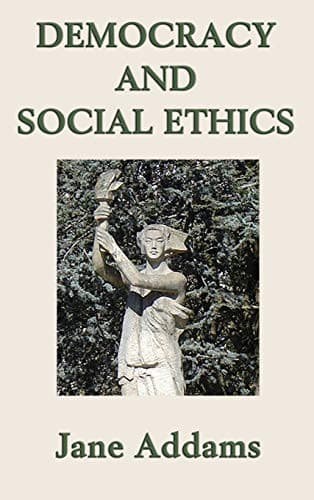
Social ethics; Social sciences; United States -- Social conditions -- 1865-1918
The alderman exhibited great wisdom in procuring from certain of his
down-town friends the sum of three thousand dollars with which to
uniform and equip a boys' temperance brigade which had been formed in
one of the ward churches a few months before his campaign. Is it strange
that the good leader, whose heart was filled with innocent pride as he
looked upon these promising young scions of virtue, should decline to
enter into a reform campaign? Of what use to suggest that uniforms and
bayonets for the purpose of promoting temperance, bought with money
contributed by a man who was proprietor of a saloon and a gambling
house, might perhaps confuse the ethics of the young soldiers? Why take
the pains to urge that it was vain to lecture and march abstract virtues
into them, so long as the "champion boodler" of the town was the man
whom the boys recognized as a loyal and kindhearted friend, the
public-spirited citizen, whom their fathers enthusiastically voted for,
and their mothers called "the friend of the poor." As long as the actual
and tangible success is thus embodied, marching whether in kindergartens
or brigades, talking whether in clubs or classes, does little to change
the code of ethics.
The question of where does the money come from which is spent so
successfully, does of course occur to many minds. The more primitive
people accept the truthful statement of its sources without any shock to
their moral sense. To their simple minds he gets it "from the rich" and,
so long as he again gives it out to the poor as a true Robin Hood, with
open hand, they have no objections to offer. Their ethics are quite
honestly those of the merry-making foresters. The next less primitive
people of the vicinage are quite willing to admit that he leads the
"gang" in the city council, and sells out the city franchises; that he
makes deals with the franchise-seeking companies; that he guarantees to
steer dubious measures through the council, for which he demands liberal
pay; that he is, in short, a successful "boodler." When, however, there
is intellect enough to get this point of view, there is also enough to
make the contention that this is universally done, that all the
aldermen do it more or less successfully, but that the alderman of this
particular ward is unique in being so generous; that such a state of
affairs is to be deplored, of course; but that that is the way business
is run, and we are fortunate when a kind-hearted man who is close to the
people gets a large share of the spoils; that he serves franchised
companies who employ men in the building and construction of their
enterprises, and that they are bound in return to give work to his
constituents. It is again the justification of stealing from the rich to
give to the poor. Even when they are intelligent enough to complete the
circle, and to see that the money comes, not from the pockets of the
companies' agents, but from the street-car fares of people like
Public-domain text, read in full here on John Shaqi.
Reviews
Reviews
No reviews yet
Be the first to share your thoughts on this work.
Elsewhere in the archive
Join the Discussion
Join the discussion
Sign in to leave a comment or review.
Sign InorCreate an account