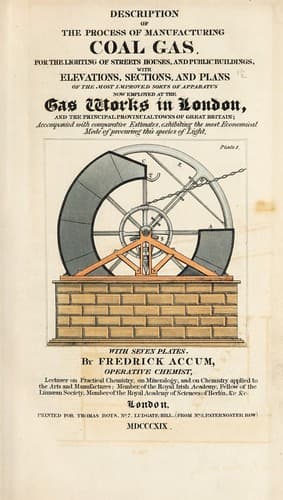
Description of the Process of Manufacturing Coal Gas, for the Lighting of Streets Houses, and Public Buildings: With Elevations, Sections, and Plans of the Most Improved Sorts of Apparatus Now Employed at the Gas Works in London and the Principal Provincial Towns of Great Britain; Accompanied With Comparative Estimates, Exhibiting the Most Economical Mode of Procuring This Species of LightAccum, Friedrich Christian
History
Description of the Process of Manufacturing Coal Gas, for the Lighting of Streets Houses, and Public Buildings: With Elevations, Sections, and Plans of the Most Improved Sorts of Apparatus Now Employed at the Gas Works in London and the Principal Provincial Towns of Great Britain; Accompanied With Comparative Estimates, Exhibiting the Most Economical Mode of Procuring This Species of Light
Accum, Friedrich Christian
Gas manufacture and works -- Great Britain; Gas-lighting
“Another advantage gained by the small quantity of gas required for a
flame, is the proportionate diminution of heat arising from the lights.
The quantities of heat and light produced by the combustion of
inflammable gases are by no means in the same constant relation to each
other; one frequently increases, whilst the other diminishes; and this
is eminently the case when coal gas and oil gas are burned against each
other. The quantity of heat liberated is, speaking generally, as the
quantity of gas consumed, and this is greatest with the coal gas; but
the quantity of light is nearly as the quantity of carbon that is well
burnt in the flame, and this is greatest in the oil gas.”
“The very compact state in which the apparatus necessary for the
decomposition of oil can be placed, the slight degree of attention
required, its certainty of action, its cleanliness, and the numerous
applications which it admits of in the use of its furnace for other
convenient or economical purposes, render it not only unobjectionable,
but useful in manufactories and establishments; and these favourable
circumstances are accompanied, not from any inferiority in the flame or
increased expense, but by an improved state of the first, and saving in
the latter.”
“Messrs. Taylor have shewn great ingenuity in the construction of their
whole apparatus, but the washer and gasometer deserve particular notice
for their remarkable simplicity also. In the washer, two planes are
fixed in a box or cistern, in a direction not quite horizontal, but
inclined a little in opposite directions; the planes are traversed
nearly across by slips of wood or metal, fixed in an inclined position
on the under surface, and which alternately touch one side of the
cistern, leaving the other open and free. These planes being immersed in
water, the gas is thrown in under the lowest ridge, and by its ascending
power is made to traverse backward and forward along the ridges fixed
on the planes, until it escapes at the highest part of the uppermost
ridge. Thus, with a pressure of five or six inches of water only, it is
made to pass through a distance of fourteen or sixteen feet under the
surface of the fluid, and becomes well washed.”
“The smaller gasometers are made of thin plate iron, and being placed in
a frame of light iron work, look more like ornamental stoves than the
bulky appendages to a gas apparatus, which they supply. The larger ones
are made very light, and when in pieces very portable, by being
constructed of a frame of wood work, in the edges of which are deep
narrow grooves; plates of iron fit into these grooves, which being
caulked in and painted over, make a light and tight apparatus. These are
easily put together in any place, and may therefore be introduced into a
small apartment, or other confined space, where a gasometer already made
up would not enter.”
For the following additional information on this subject, I am indebted
to Messrs. J. and P. Taylor.
Public-domain text, read in full here on John Shaqi.
Reviews
Reviews
No reviews yet
Be the first to share your thoughts on this work.
Elsewhere in the archive
Join the Discussion
Join the discussion
Sign in to leave a comment or review.
Sign InorCreate an account