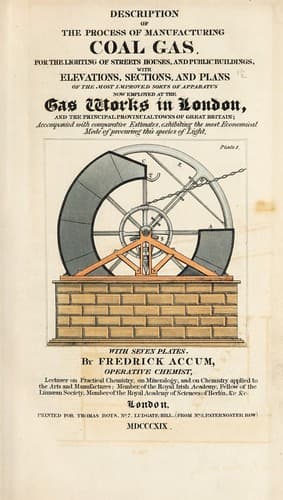
Description of the Process of Manufacturing Coal Gas, for the Lighting of Streets Houses, and Public Buildings: With Elevations, Sections, and Plans of the Most Improved Sorts of Apparatus Now Employed at the Gas Works in London and the Principal Provincial Towns of Great Britain; Accompanied With Comparative Estimates, Exhibiting the Most Economical Mode of Procuring This Species of LightAccum, Friedrich Christian
History
Description of the Process of Manufacturing Coal Gas, for the Lighting of Streets Houses, and Public Buildings: With Elevations, Sections, and Plans of the Most Improved Sorts of Apparatus Now Employed at the Gas Works in London and the Principal Provincial Towns of Great Britain; Accompanied With Comparative Estimates, Exhibiting the Most Economical Mode of Procuring This Species of Light
Accum, Friedrich Christian
Gas manufacture and works -- Great Britain; Gas-lighting
1430 pounds of coal tar, produce 360 pounds of essential oil. The
residue left after the distillation is
_Pitch._
If the coal tar is wanted to be converted into pitch, without obtaining
the oil which it is capable of furnishing, the evaporation of it may be
performed in a common boiler; but as it is extremely liable to boil
over, the greatest precaution is necessary in conducting the
evaporation. A spout or rim is added to the common boiler into which the
tar spreads itself as it rises, and by this means becomes cooled, and
the boiling over is checked.
1430 pounds of coal tar produce 9 cwt. of pitch. A subsequent
evaporation with a gentle heat, converts the coal pitch into a substance
greatly resembling _asphaltum_.
_Manufacture of Carbonate of Ammonia from the Ammoniacal Liquor of Pit
Coal._
The ammoniacal liquor obtained in the gas light manufacture, is employed
for the production of carbonate of ammonia. The average quantity of this
liquor, obtainable from a chaldron, (27 cwt.) of Newcastle, or
Sunderland coal, amounts to from 180 to 220 pounds. It is chiefly
composed of carbonate and sulphate of ammonia. The quantity of ammonia
contained in it, varies considerably. The strongest liquor is obtained
from coal that readily cake, (page 45); a gallon (or eight and a half
pounds weight) of ammoniacal liquor usually requires for saturation,
from fifteen to sixteen ounces of sulphuric acid of a specific gravity
1,84. The weakest ammoniacal liquor is obtained from those species of
coal which do not cake, and which by a single combustion are reduced to
light ashes. It requires only from eight to ten ounces of sulphuric
acid, of the before mentioned specific gravity for its saturation.
The following process is employed in the large way, for obtaining
carbonate of ammonia from the ammoniacal liquor. To 108 gallons[62] of
the liquor contained in a cask, are added 125 pounds[63] of finely
ground sulphate of lime, which has been previously deprived of moisture
by heat. The cask is bunged up, and the mixture after being stirred
together for a few minutes, is left undisturbed for three or four hours.
Sixteen ounces of sulphuric acid are then added, the mixture is again
agitated, and is again suffered to stand undisturbed for four or six
hours. If the liquor be now examined, it will turn blue litmus paper,
red.
[62] One gallon of the strongest ammoniacal liquor, weighs eight and a
half pounds.
[63] This quantity is evidently too large, but the workmen assert,
that an excess of sulphate of lime causes the carbonate of lime which
is formed, to subside more readily, and the excess of sulphate of lime
can do no injury.
Public-domain text, read in full here on John Shaqi.
Reviews
Reviews
No reviews yet
Be the first to share your thoughts on this work.
Elsewhere in the archive