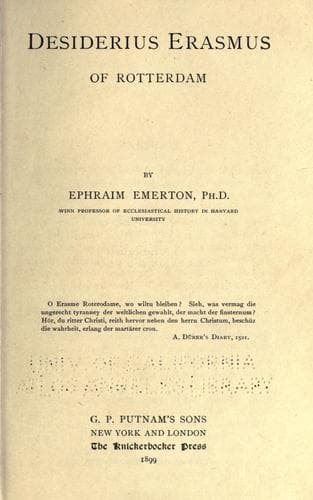
"Oh! Erasmus of Rotterdam, where art thou? Behold what the
unjust tyranny of earthly power, the might of darkness, can do.
Hear, thou champion of Christ! ride forth by the side of the
Lord Christ; defend the truth; gain the martyr's crown! As it
is, thou art but a frail old man. I have heard thee say thou
hadst given thyself but a couple more years of active service;
spend them, I pray, to the profit of the Gospel and the true
Christian faith and believe me the gates of Hell, the See of
Rome, as Christ has said, will not prevail against thee. And
though thou becomest like thy master Christ and bearest shame
from the liars of this world and so diest a little earlier,
yet wilt thou so much the sooner pass from death unto life and
be glorified in Christ. For if thou shalt drink of the cup he
drank of, so wilt thou reign with him and judge with equity them
that have done foolishness. O Erasmus! stand by us, that God may
praise thee, as is written of David; for thou art mighty and
thou canst slay Goliath; for God stands by the holy Christian
churches, as he stands also among the Romans, according to his
divine will."
Doubtless this heartfelt petition of the excellent Dürer represents
the first impulse of many an honest soul who thought of Erasmus as
a man straightforward as himself, and without any special knowledge
of him jumped to the conclusion that here was the natural leader of
a redeemed generation. No such illusion could long affect anyone who
had come to know him in his true character.
[Illustration: ERASMUS.
FROM A COPPER ENGRAVING BY ALBERT DÜRER.]
It is somewhat difficult to imagine what Erasmus would have done if
his personal safety had been seriously brought into question. It
is not impossible that, if the issue of retraction or punishment
had ever been squarely presented to him by any authority capable of
enforcing its judgment, he might have risen to a higher plane of
action than he was ever in fact called upon to reach. Such attacks
as he had to meet were wholly from individuals, representing no
recognised authority either of Church or State, and his defence was
always that the highest persons in both these worlds had approved
him. This judgment is at all events more favourable than Erasmus was
sometimes inclined to demand for himself. Writing to Richard Pace
in the critical year 1521 he says[140]:
[140] iii.¹, 651-C.
Public-domain text, read in full here on John Shaqi.
Reviews
Reviews
No reviews yet
Be the first to share your thoughts on this work.
Elsewhere in the archive
Join the Discussion
Join the discussion
Sign in to leave a comment or review.
Sign InorCreate an account