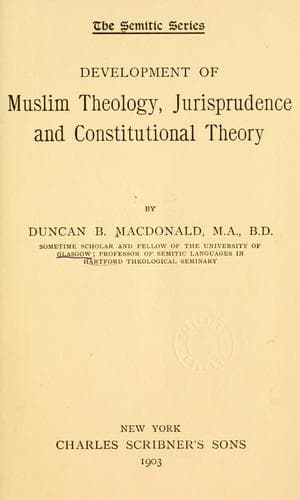
Development of Muslim Theology, Jurisprudence, and Constitutional TheoryMacDonald, Duncan Black
ReligionIslamic
Development of Muslim Theology, Jurisprudence, and Constitutional Theory
MacDonald, Duncan Black
Constitutional law (Islamic law); Islam -- Doctrines -- History; Islam and state -- History; Islamic law -- History
But truth for him is not to be reached by speculation and argument:
its only basis is through the unveiling of the inner eye which brings
us to the immediate Vision of the Divine. Those who have reached that
Vision, guide and teach those who cannot or have not. Upon that Vision
all systems are built, and reason can only serve the visionary as a
defence against the gainsayer or against his own too wild thoughts.
Naturally, with such a starting-point as this the supernatural side of
things (_al-ghayb_) receives strong emphasis. The Jinn and the angels are
most intense realities. Ash-Sha‘rani met them in familiar converse. He
met, too, al-Khadir, the undying pilgrim saint who wanders through the
lands, succoring and guiding. The details of these interviews are given
with the greatest exactness. A Jinni in the form of a dog ran into his
house on such a day by such a door, with a piece of European paper in his
mouth—this is a touch of genius—on which certain theological questions
were written. The Jinni wished ash-Sha‘rani’s opinion as to them. Such
was the origin of one of his books, and another sprang from a similarly
exactly described talk with al-Khadir. Yet he was content also with
smaller mercies and reckons as a _karama_ that he was enabled to read
through a certain book for some time at the rate of two and a half times
daily. To all this it would be possible of course to say flatly that he
lied. But such a judgment applied to an oriental is somewhat crude, and
the knot of the mystic’s mind in any land is not to be so easily cut.
Further, the doctrine of the _walis_ is developed by him at length. They
possess a certain illumination (_ilham_), which is, however, different
from the inspiration (_wahy_) of the prophets. So, too, they never reach
the grade of the prophets, or a nearness to God where the requirements
of a revealed law fall away from them, _i.e._, they must always walk
according to the law of a prophet. They are all guided by God, whatever
their particular Rule (_tariqa_) may be, but the Rule of al-Junayd (p.
176) is the best because it is in most essential agreement with the Law
(_shari‘a_) of Islam. Their _karamat_ are true and are a consequence of
their devout labors, for these are in agreement with the Qur’an and the
Sunna. The order of nature will not be broken for anyone who has not
achieved more than is usual in religious knowledge and exercises. All
_walis_ stand under a regular hierarchy headed by the Qutb; yet above
him in holiness stand the Companions of the Prophet. This marks a very
moderate position. Many Sufis had contended that the _walis_ stood higher
than even the prophets, not to speak of their Companions.
Public-domain text, read in full here on John Shaqi.
Reviews
Reviews
No reviews yet
Be the first to share your thoughts on this work.
Elsewhere in the archive
Join the Discussion
Join the discussion
Sign in to leave a comment or review.
Sign InorCreate an account