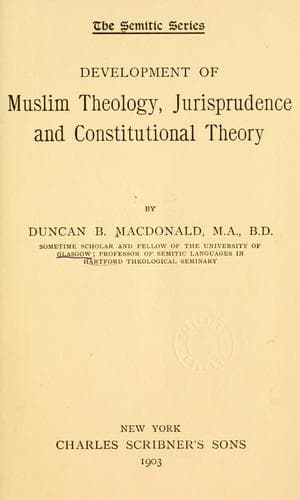
Development of Muslim Theology, Jurisprudence, and Constitutional TheoryMacDonald, Duncan Black
ReligionIslamic
Development of Muslim Theology, Jurisprudence, and Constitutional Theory
MacDonald, Duncan Black
Constitutional law (Islamic law); Islam -- Doctrines -- History; Islam and state -- History; Islamic law -- History
The Muslims cannot do without a leader (_Imam_) who shall occupy
himself with the enforcing of their decisions, and in maintaining their
boundaries and guarding their frontiers, and equipping their armies,
and receiving their alms, and putting down robberies and thieving and
highwaymen, and maintaining the Friday services and the Festivals, and
removing quarrels that fall between creatures, and receiving evidence
bearing on legal claims, and marrying minors, male and female, and those
who have no guardians, and dividing booty. And it is necessary that the
leader should be visible, not hidden and expected to appear (_muntazar_),
and that he should be of the tribe of Quraysh and not of any other. And
he is not assigned exclusively to the sons of Hashim nor to the children
of Ali. And it is not a condition that he should be protected by God from
sin (_isma_), nor that he should be the most excellent of the people
of his time, but it is a condition that he should have administrative
ability, should be a good governor and be able to carry out decrees and
to guard the restrictive ordinances (_hadds_) of Islam and to protect the
wronged against him who wrongs him. And he is not to be deposed from the
leadership on account of immorality or tyranny.
Prayer is allowable behind anyone whether pure or a sinner. And we give
the salutation of Peace to the pure and to the sinner.
And we abstain from the mention of the Companions (_sahibs_) of the
Prophet except with good.
And we bear witness that Paradise is for the ten to whom the
Prophet—God bless him and give him Peace!—gave good tidings of Paradise
(_al-asharatu-l-mubashshara_).
And we approve the wiping (_mash_) of the inner-shoes (_khuffs_) both at
home and when on a journey.
And we do not regard _nabidh_ as forbidden.
And the Saint does not reach the level of the Prophets. And the creature
does not come to a point where commands and prohibitions and the details
of the statutes in their outward sense (_zahir_) fall away from him; and
the turning aside from these to the views which the People of the Inner
Meaning (_batin_) assert is a deviation (_ilhad_) through unbelief.
And feeling safe from God is unbelief. And despairing of God is unbelief.
And rejection of the statutes and contempt for the law is unbelief. And
believing a diviner (_kahin_) in what he tells of the Unseen (_ghayb_) is
unbelief. And what does not exist (_ma‘dum_) is known of God Most High
just as what exists (_mawjud_) is known of Him and it [_i.e._, what does
not exist] is neither a thing (_shay_) nor an object of vision (_mar’an_).
And in prayer of the living for the dead, and in alms offered for them
there is an advantage to them. And God Most High answers prayers and
supplies needs.
Public-domain text, read in full here on John Shaqi.
Reviews
Reviews
No reviews yet
Be the first to share your thoughts on this work.
Elsewhere in the archive
Join the Discussion
Join the discussion
Sign in to leave a comment or review.
Sign InorCreate an account