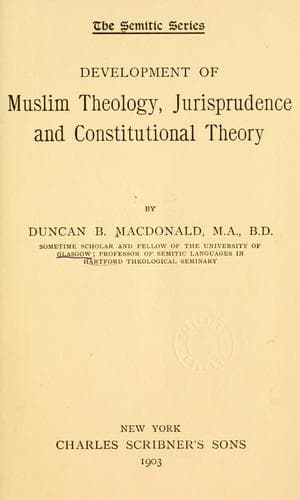
Development of Muslim Theology, Jurisprudence, and Constitutional TheoryMacDonald, Duncan Black
ReligionIslamic
Development of Muslim Theology, Jurisprudence, and Constitutional Theory
MacDonald, Duncan Black
Constitutional law (Islamic law); Islam -- Doctrines -- History; Islam and state -- History; Islamic law -- History
On these three distinctions, then, is based the science of the articles
of belief; and these three are necessary for every _mukallaf_ [one who
has a task imposed upon him; in this case of religious duty], male and
female, for that upon which the necessary is based is necessary. The
Imam al-Haramayn (d. 478) even held that an understanding of these three
constituted reason itself and that he who did not know the meaning of
necessary, impossible and possible, was not a reasoning being. So,
whenever it is said here that Power is necessary (_wajib_) in God, the
meaning is that the intellect cannot affirm its non-existence, because
the necessary is that the non-existence of which the intellect cannot
affirm, as has preceded. But necessary (_wajib_, incumbent) in the sense
of that the not doing of which is punished, is an idea which does not
enter into the science of the divine Unity. So, do not let the matter be
confused for you. It is true that if one says that belief in the Power
of God is incumbent (_wajib_) on the _mukallaf_, the meaning is that
he is rewarded for that and punished for omitting that. Thus there is
a distinction between saying that belief in such and such is incumbent
and that the knowledge, for example, is necessary. For when it is said
that knowledge is necessary in God, the meaning is that the intellect
cannot affirm the non-existence of knowledge in God. But when it is said
that belief in that knowledge is incumbent, the meaning is that belief
in it is rewarded and lack of belief punished. So, apply thyself to the
distinction between the two and be not of those who regard _taqlid_ in
the articles of Religion as right, that so your faith (_iman_) should
differ from the truth and you should abide in the Fire, according to
those who hold that _taqlid_ does not suffice. As-Sanusi said, “A person
is not a Believer when he says, ‘I hold by the Articles and will not
abandon them though I be cut in pieces;’ nay, he is not a Believer until
he knows each Article of the fifty, along with its proof.” And this
science of theology must be studied first of all sciences, as may be
gathered from the commentary [by at-Taftazani, d. 791] on as-Sanusi’s
_Articles_; for he made this science a foundation on which other things
are built. So a judgment as to anyone’s ceremonial ablution (_wudu_) or
prayer is not valid unless the person in question knows these articles
or, on the other hand, holds them without proof.
* * * * *
Now, let us state to you the fifty articles shortly, before stating them
in detail. Know, then, that twenty qualities are necessary in God Most
High, that twenty are impossible in Him and that one is possible. This
makes up forty-one. And in the case of the Apostles, four qualities are
necessary, four impossible and one possible. This makes up the fifty.
And there shall come an accurate account of doctrines along with the
statement of them, if it be the will of God Most High.
Public-domain text, read in full here on John Shaqi.
Reviews
Reviews
No reviews yet
Be the first to share your thoughts on this work.
Elsewhere in the archive
Join the Discussion
Join the discussion
Sign in to leave a comment or review.
Sign InorCreate an account