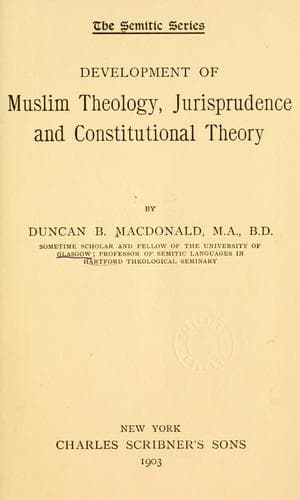
Development of Muslim Theology, Jurisprudence, and Constitutional TheoryMacDonald, Duncan Black
ReligionIslamic
Development of Muslim Theology, Jurisprudence, and Constitutional Theory
MacDonald, Duncan Black
Constitutional law (Islamic law); Islam -- Doctrines -- History; Islam and state -- History; Islamic law -- History
And the belief is also incumbent that God may be seen in the Other World
by believers, for He has joined the seeing (_ru’ya_) of Him with the
standing fast of the mountain in His saying (Qur. 7, 139), “And if it
standeth fast in its place, thou wilt see Me.” And the standing fast
of the mountain was possible: then, that which is connected with it of
seeing must also have been possible; because what is connected with the
possible is possible. But our seeing God must be without inquiring how
(_bila kayfa_); it is not like our seeing one another. God is not seen in
a direction, nor in a color, nor in a body; He is far removed from that.
And the Mu‘tazilites—may God make them vile!—deny the seeing of God. That
is one of their perverse and false articles of belief. And another of
their corrupt articles is their saying that the creature creates his own
actions. For this, they are called Qadarites, because they say that the
actions of the creature are by his own _qudra_ (power), just as the sect
which holds that the creature is forced to the action he does, is called
Jabrite, derived from their holding a being forced (_jabr_) on the part
of the creature, and a being compelled. It, too, is a perverse article.
And the truth is that the creature does not create his own actions and
is not forced, but that God creates the actions which issue from the
creature, along with the creature’s having a free choice (_ikhtiyar_)
in them. As-Sa‘d [Sa‘d ad-Din at-Taftazani, see above] said, in his
commentary on the _Articles_, “It is not possible to render this free
choice by any expression, but the creature finds a difference between the
movement of his hand when he moves it himself and when the wind moves it
against his will.”
And to that which is possible in God belongs also the sending of a number
of Apostles (_rasuls_). And God’s sending them is by His grace, and by
way of necessity, as has preceded.
And it is necessary to confess that the most excellent of created beings,
absolutely, is our Prophet [Muhammad], and there follow him in excellency
the rest of the Endowed with Earnestness and Patience (_ulu-l-azm_; see
Qur. 46, 34); they are our Lord Ibrahim, our Lord Musa, our Lord Isa, and
our Lord Nuh; and this is their order in excellency. And that they are
five along with our Prophet, and four after him is the correct view. And
it is said, too, that the Endowed with Earnestness and Patience are more
numerous. And there follow them in excellency the rest of the Apostles.
Then, the rest of the Prophets (_nabis_), then the Angels.
Public-domain text, read in full here on John Shaqi.
Reviews
Reviews
No reviews yet
Be the first to share your thoughts on this work.
Elsewhere in the archive
Join the Discussion
Join the discussion
Sign in to leave a comment or review.
Sign InorCreate an account