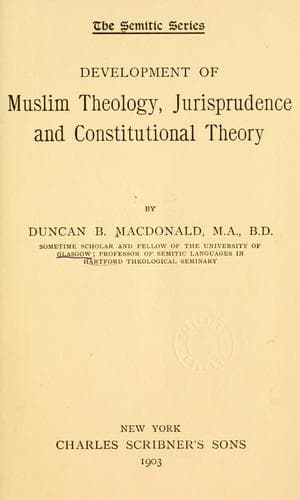
Development of Muslim Theology, Jurisprudence, and Constitutional TheoryMacDonald, Duncan Black
ReligionIslamic
Development of Muslim Theology, Jurisprudence, and Constitutional Theory
MacDonald, Duncan Black
Constitutional law (Islamic law); Islam -- Doctrines -- History; Islam and state -- History; Islamic law -- History
The problem of the Abbasids; the House of Barmak; the crumbling
of the empire; the Prætorians of Baghdad; the Buwayhids;
the situation of the Khalifa under them; the Saljuqs; the
possibilities of development under them; the Mongols and the
Abbasid end; the Egyptian Abbasids; the Ottoman Sultans, their
heirs; theory of the Khalifate; the modern situation; the signs
of sovereignty for Muslims; five grounds of the claim of the
Ottoman Sultan; the consequences for the Sultan; other Muslim
constitutions; the Shi‘ites; the Ibadites; the Wahhabites; the
Brotherhood of as-Sanusi.
[Sidenote: CRUMBLING OF THE EMPIRE]
We must now return to the Abbasids, whose empire we left crumbling away.
It was a shrewd stroke of policy on the part of its founder to put the
new capital, Baghdad, on the Tigris, right between Persia, Syria and
Arabia. For the only hope of permanence to the empire lay in welding
these into a unity. For a short time, in the hands of the first vigorous
rulers, and, especially, during fifty years of guidance by the House of
Barmak—Persians who flung in their lot with the Abbasids and were their
stay till the madness of Harun ar-Rashid cast them down—this seemed to be
succeeding; but, just as the empire of Charlemagne melted under his sons,
so did the empire of al-Mansur and al-Ma’mun. The Bedawi tribes fell
back into the desert and to the free chaos of the old pre-Islamic life.
As the great philosophical historian, Ibn Khaldun, has remarked, the
Arabs by their nature are incapable of founding an empire except when
united by religious enthusiasm, and are of all peoples least capable of
governing an empire when founded. After the first Abbasids, it is a fatal
error to view the Muslim dynasties as Arab or to speak of the Muslim
civilization as Arabian. The conquered peoples overcame their conquerors.
Persian nationalism reasserted itself and in native independent dynasties
flung off the Arab yoke. These dynasties were mostly Shi‘ite; Shi‘ism,
in great part, is the revolt of the Aryan against Semitic monotheism.
The process in all this was gradual but certain. Governors of provinces
revolted and became semi-independent. Sometimes they acknowledged a
shadowy sovereignty of the Khalifa, by having his name on their coins
and in the Friday prayers; sometimes they did not. At other times they
were, or claimed to be, Alids, and when Alids revolted, they revolted
absolutely. With them, it was a question of conscience. At last, not even
in his own City of Peace or in his own palace was the Khalifa master.
As in Rome, so in Baghdad, a body-guard of mercenaries assumed control
and their leader was _de facto_ ruler. Later, from A.H. 320 to 447 (A.D.
932-1055), the Sunnite Khalifa found himself the ward and puppet of
the Shi‘ite Buwayhids. Baghdad itself they held from 334. But still,
a curious spiritual value—we cannot call it authority—was left to the
shadowy successors of Muhammad.
Public-domain text, read in full here on John Shaqi.
Reviews
Reviews
No reviews yet
Be the first to share your thoughts on this work.
Join the Discussion
Join the discussion
Sign in to leave a comment or review.
Sign InorCreate an account