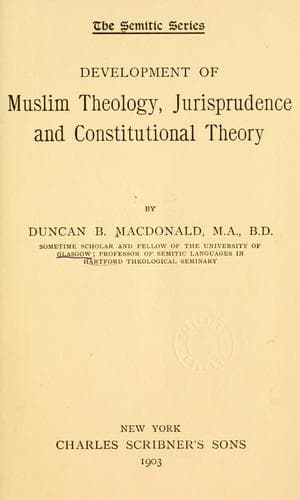
Development of Muslim Theology, Jurisprudence, and Constitutional TheoryMacDonald, Duncan Black
ReligionIslamic
Development of Muslim Theology, Jurisprudence, and Constitutional Theory
MacDonald, Duncan Black
Constitutional law (Islamic law); Islam -- Doctrines -- History; Islam and state -- History; Islamic law -- History
that a Muslim who apostatized to Christianity should not be put to death.
But, mingled with this indifference, there appeared a strange but regular
development of Shi‘ite doctrine. Some of his followers began to proclaim
openly that the deity was incarnate in him, and it was evident that he
himself accepted and believed this. But the Egyptian populace would have
none of it, and the too rash innovators had to flee. Some went to the
Lebanon and there preached to the native mountain tribes. The results of
their labors are the Druses of to-day, who worship al-Hakim still and
expect his return to introduce the end of all things. Finally, al-Hakim
vanished on the night of February 12, A.D. 1021, and left a mystery
unread to this day. Whether he was murdered, and if so why, or vanished
of free-will, and if so again why, we have no means of telling. Our
guess will depend upon our reading of his character. So much is certain,
that he was a ruler of the autocratic type, who introduced many reforms,
most of which the people of his time could not in the least understand
and therefore misrepresented as the mere whims of a tyrant, and many of
which, from our ignorance, are still obscure to us. If we can imagine
such a man of strong personality and desire for the good of his people
but with a touch of madness in the brain, cast thus in the midst between
his orthodox subjects and a wholly unbelieving inner government, we shall
perhaps have the clew to the strange stories told of him.
[Sidenote: THE ASSASSINS]
Another product of this conspiracy, and the last to which we shall
refer, is the sect known as the Assassins, whose Grand Master was a name
of terror to the Crusaders as the Old Man of the Mountain. It, too,
was founded, and apparently for a purpose of personal vengeance, by a
Persian who began as a Shi‘ite and ended as nothing. He came to Egypt,
studied under the Fatimids—they had established at Cairo a great school
of science—and returned to Persia as their agent to carry on their
propaganda. His methods were the same as theirs, with a difference.
That was the reduction of assassination to a fine art. From his eagle’s
nest of Alamut—such is the meaning of the name—and later from Masyaf in
the Lebanon and other mountain fortresses, he and his successors spread
terror through Persia and Syria and were only finally stamped out by the
Mongol flood under Hulagu in the middle of the seventh century of the
Hijra (the 13th A.D.). Of the sect there are still scattered remnants
in Syria and India, and as late as 1866 an English judge at Bombay had
to decide a case of disputed succession according to the law of the
Assassins. Finally, the Fatimid dynasty itself fell before the Kurd,
Salah ad-Din, the Saladin of our annals, and Egypt was again orthodox.
CHAPTER III
Public-domain text, read in full here on John Shaqi.
Reviews
Reviews
No reviews yet
Be the first to share your thoughts on this work.
Join the Discussion
Join the discussion
Sign in to leave a comment or review.
Sign InorCreate an account