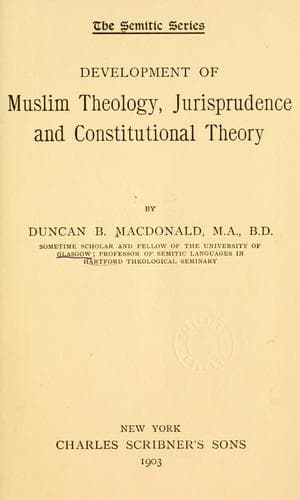
Development of Muslim Theology, Jurisprudence, and Constitutional TheoryMacDonald, Duncan Black
ReligionIslamic
Development of Muslim Theology, Jurisprudence, and Constitutional Theory
MacDonald, Duncan Black
Constitutional law (Islamic law); Islam -- Doctrines -- History; Islam and state -- History; Islamic law -- History
Again the two signs of sovereignty for Muslims are that the name of the
sovereign should be on the coinage and that he should be prayed for in
the Friday sermon (_khutba_). In India, the custom seems to be to pray
for “the ruler of the age” without name; then each worshipper can apply
it as he chooses. But there has crept in a custom in a few mosques of
praying for the Ottoman Sultan as the Khalifa; the English government
busies itself little with these things until compelled, and the custom
will doubtless spread. The Ottoman Sultan is certainly next greatest to
the Emperor of India and would seem, as a Muslim ruling Muslims, to have
an unassailable position. But in his case also difficult and ambiguous
constitutional questions can be raised. He has claimed the Khalifate, as
we have seen, since 1538, but the claim is a shaky one and brings awkward
responsibilities. As stated at the present day, it has five grounds.
First, _de facto_ right; the Ottoman Sultan won his title by the sword
and holds it by the sword. Second, election; this form has been already
described. Third, nomination by the last Abbasid Khalifa of Egypt; so
Abu Bakr nominated Umar to succeed him, and precedent is everything
in Islam. Fourth, possession and guardianship of the two Harams, or
Sacred Cities, Mecca and al-Madina. Fifth, possession of some relics
of the Prophet saved from the sack of Baghdad and delivered to Sultan
Salim, on his conquest of Egypt, by the last Abbasid. But these all
shatter against the fixed fact that absolutely accepted traditions from
the Prophet assert that the Khalifa must be of the family of Quraysh;
so long as there are two left of that tribe, one must be Khalifa and
the other his helper. Still, here, as everywhere, the principal of
Ijma, Agreement of the Muslim people, (see p. 105) comes in and must
be reckoned with. These very traditions are probably an expression in
concrete form of popular agreement. The Khalifate itself is confessedly
based upon agreement. The canon lawyers state the case thus: The Imamites
and Isma‘ilians hold that the appointment of a leader is incumbent
upon God. There is only the difference that the Imamites say that a
leader is necessary in order to maintain the laws unimpaired, while the
Isma‘ilians regard him as essential in order to give instruction about
God. The Kharijites, on the other hand, recognize no fundamental need
of an Imam; he is only allowable. Some of them held that he should be
appointed in time of public trouble to do away with the trouble, thus a
kind of dictator; others, in time of peace, because only then can the
people agree. The Mu‘tazilites and the Zaydites held that it was for man
to appoint, but that the necessity was based on reason; men needed such
a leader. Yet some Mu‘tazilites taught that the basis was partly reason
and partly obedience to tradition. On the other hand, the Sunnites hold
that the appointment of an Imam is incumbent upon men and that the basis
Public-domain text, read in full here on John Shaqi.
Reviews
Reviews
No reviews yet
Be the first to share your thoughts on this work.
Join the Discussion
Join the discussion
Sign in to leave a comment or review.
Sign InorCreate an account