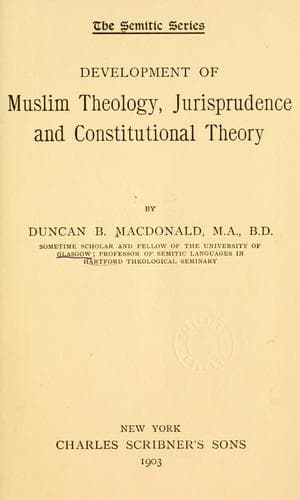
Development of Muslim Theology, Jurisprudence, and Constitutional TheoryMacDonald, Duncan Black
ReligionIslamic
Development of Muslim Theology, Jurisprudence, and Constitutional Theory
MacDonald, Duncan Black
Constitutional law (Islamic law); Islam -- Doctrines -- History; Islam and state -- History; Islamic law -- History
is obedience to the tradition of the Agreement of the Muslim world from
the earliest times. The community of Islam may have disputed over the
individual to be appointed, but they never doubted that the maintenance
of the faith in its purity required a leader, and that it was, therefore,
incumbent on men to appoint one. The basis is Ijma, Agreement, not
Scripture or tradition from Muhammad or analogy based on these two.
It will be seen from this that the _de facto_ ground to the claim of the
Ottoman Sultan is the best. The Muslim community must have a leader;
this is the greatest Muslim ruling Muslims; he claims the leadership and
holds it. If the English rule were to become Muslim, the Muslims would
rally to it. The ground of election amounts to nothing, the nomination
to little more, except for antiquarians; the possession of the Prophetic
relics is a sentiment that would have weight with the crowd only; no
canon lawyer would seriously urge it. The guardianship of the two Harams
is precarious. A Turkish reverse in Syria would withdraw every Turkish
soldier from Arabia and the great Sharif families of Mecca, all of the
blood of the Prophet, would proclaim a Khalifa from among themselves. At
present, only the Turkish garrison holds them in check.
[Sidenote: PAN-ISLAMISM]
But a Khalifa has responsibilities. He absolutely cannot become a
constitutional monarch in our sense. He rules under law—divine law—and
the people can depose him if he breaks it; but he cannot set up beside
himself a constitutional assembly and give it rights against himself. He
is the successor of Muhammad and must rule, within limitations, as an
absolute monarch. So impossible is the modern Khalifate, and so gigantic
are its responsibilities. The millions of Chinese Muslims look to him and
all Muslims of central Asia; the Muslims of India who are not Shi‘ite
also look to him. So, too, in Africa and wherever in the world the People
of Muhammad have gone, their eyes turn to the Bosphorus and the Great
Sultan. This is what has been called the modern Pan-Islamic movement; it
is a modern fact.
The position of the other Muslim sects we have already seen. Of Shi‘ite
rulers, there are the Imamites in Persia; scattered Zaydites still
in south Arabia and fugitive in Africa; strange secret bodies of
Isma‘ilians—Druses, Nusayrites, Assassins—still holding their own in
mountain recesses, forgotten by the world; oldest of all, the Sharifs
of Morocco, who are Sunnites and antedate all theological differences,
holding only by the blood of the Prophet. At Zanzibar, Uman and the Mzab
in Algeria are the descendants of the Kharijites. Probably, somewhere
or other, there are some fossilized descendants of every sect that has
ever arisen, either to trouble the peace of Islam or to save it from
scholastic decrepitude and death. Insurrections and heresies have their
own uses.
Public-domain text, read in full here on John Shaqi.
Reviews
Reviews
No reviews yet
Be the first to share your thoughts on this work.
Join the Discussion
Join the discussion
Sign in to leave a comment or review.
Sign InorCreate an account