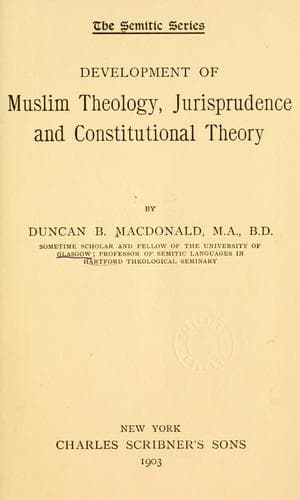
Development of Muslim Theology, Jurisprudence, and Constitutional TheoryMacDonald, Duncan Black
ReligionIslamic
Development of Muslim Theology, Jurisprudence, and Constitutional Theory
MacDonald, Duncan Black
Constitutional law (Islamic law); Islam -- Doctrines -- History; Islam and state -- History; Islamic law -- History
It only remains to make mention of two modern movements which have
deeply affected the Islam of to-day. The Pan-Islamic movement, noticed
above, strives as much as anything to bring the Muslim world into closer
touch with the science and thought of the Christian world, rallying all
the Muslim peoples at the same time round the Ottoman Sultan as their
spiritual head and holding fast by the kernel of Islam. It is a reform
movement whose trend is forward. The other two, to which we now come, are
reform movements also, but their trend is backward. They look to the good
old days of early Islam and try to restore them.
The first is that of the Wahhabites, so called from Muhammad ibn Abd
al-Wahhab (Slave of the Bountiful), its founder, a native of Najd in
central Arabia, who died in 1787. His aim was to bring Islam back to its
primitive purity and to do away with all the usages and beliefs which
had arisen to cloud its absolute monotheism. But attempts at reformation
in Islam have never led to anything but the founding of new dynasties.
They may begin with a saintly reformer, but in the first or the second
generation there is sure to come the conquering disciple; religion and
rule go together, and he who meddles with the one must next grasp at
the other. The third stage is the extinction of the new dynasty and the
vanishing of its party into a more or less secret sect, the vitality of
which is again directed into religious channels. The Wahhabites were
no exception. Their rule extended from the Persian Gulf to the Red
Sea, touched al-Yaman and Hadramawt and included some districts of the
Pashalik of Baghdad. That was early in the nineteenth century; but now,
after many dynastic changes, the rule of the Wahhabites proper has almost
ceased, although the Turks have not gained any new footing in Najd.
There, a native Arab dynasty has sprung up which is free from Turkish
control in every respect, and has its seat in Ha’il. But the zeal of the
Wahhabites gave an impulse to reform in the general body of Muslims
which is not yet, by any means, extinct. Especially in India, their views
have been widely spread by missionaries, and at one time there was grave
fear of a Wahhabite insurrection. But dead parties in Islam seldom rise
again, and the life of Wahhabism has passed into the Muslim Church as a
whole. Politically it has failed, but the spirit of reform remains and
has undoubtedly influenced the second reform movement to which we now
come.
[Sidenote: BROTHERHOOD OF AS-SANUSI]
Public-domain text, read in full here on John Shaqi.
Reviews
Reviews
No reviews yet
Be the first to share your thoughts on this work.
Join the Discussion
Join the discussion
Sign in to leave a comment or review.
Sign InorCreate an account