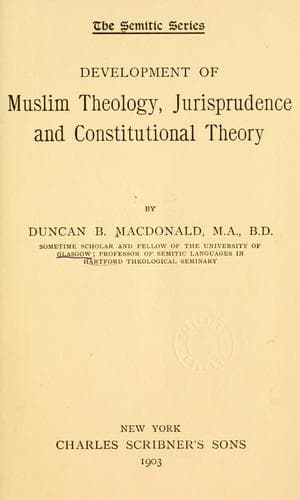
Development of Muslim Theology, Jurisprudence, and Constitutional TheoryMacDonald, Duncan Black
ReligionIslamic
Development of Muslim Theology, Jurisprudence, and Constitutional Theory
MacDonald, Duncan Black
Constitutional law (Islamic law); Islam -- Doctrines -- History; Islam and state -- History; Islamic law -- History
So there has sprung up in Islam, in tremendous ramifications, an
_imperium in imperio_. All the brethren in all the degrees—for, just
as in the monastic orders of Europe, there are active members and lay
members—reverence and pay blind obedience to the Head in his inaccessible
oasis in the African desert. There he works toward the end, and there
can be little doubt what that end will be. Sooner or later Europe—in
the first instance, England in Egypt and France in Algeria—will have to
face the bursting of this storm. For this Mahdi is different from him of
Khartum and the southern Sudan in that he knows how to rule and wait; for
years he has gathered arms and munitions, and trained men for the great
_Jihad_. When his plans are ready and his time is come, a new chapter
will be opened in the history of Islam, a chapter which will cast into
forgetfulness even the recent volcanic outburst in China. It will then
be for the Ottoman Sultan of the time to show what he and his Khalifate
are worth. He will have to decide whether he will throw in his lot with
a Mahdi of the old Islam and the dream of a Muslim millennium, or boldly
turn to new things and carry the Successorship and the People of Muhammad
to join the civilized world.
PART II
Development of Jurisprudence
CHAPTER I
The scope of jurisprudence among Muslims; the earliest elements
in it, Arab custom, Jewish law, personality of Muhammad; his
attitude toward law; elements after death of Muhammad; Qur’an,
Usage of the Prophet, common law of al-Madina; conception
of _Sunna_ before Muhammad and after; traditions and their
transmission; traditions in book form; influence of Umayyads;
forgery of traditions; the _Muwatta_ of Malik ibn Anas; the
_Musnad_ of Ahmad ibn Hanbal; the _musannafs_; al-Bukhari;
Muslim; Ibn Maja; at-Tirmidhi; an-Nasa’i; al-Baghawi; the
problem of the Muslim lawyers; their sources; Roman law; the
influence of the doctrine of the _Responsa prudentium_; Opinion
in Islam; the Law of Nature or Equity in Islam; _istihsan_;
_istislah_; Analogy; the patriarchal period in Islam; the
Umayyad period; the growth of the canon law.
Public-domain text, read in full here on John Shaqi.
Reviews
Reviews
No reviews yet
Be the first to share your thoughts on this work.
Join the Discussion
Join the discussion
Sign in to leave a comment or review.
Sign InorCreate an account