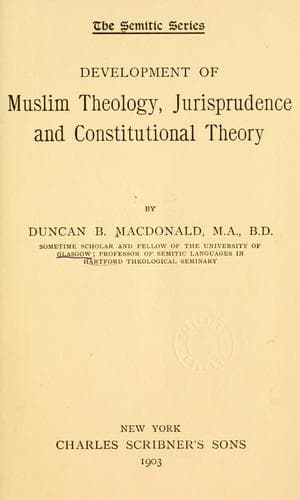
Development of Muslim Theology, Jurisprudence, and Constitutional TheoryMacDonald, Duncan Black
ReligionIslamic
Development of Muslim Theology, Jurisprudence, and Constitutional Theory
MacDonald, Duncan Black
Constitutional law (Islamic law); Islam -- Doctrines -- History; Islam and state -- History; Islamic law -- History
In tracing the development of Muslim jurisprudence few of the
difficulties are encountered which surrounded Sir Henry Maine when he
first examined the origins and history of European law. We do not need
to push our researches back to the primitive family, nor to work our way
through periods of centuries guided by the merest fragments of documents
and hints of usage. Our subject was born in the light of history; it ran
its course in a couple of hundred years and has left at every important
point authoritative evidences of its whence, its how, and its whither.
Our difficulties are different, but sufficiently great. Shortly, they are
two. The mass of material is overpowering; the strangeness of the ideas
involved is perplexing. The wealth of material will become plain, to some
extent at least, as the history is traced; but for the strangeness of
the contents, of the arrangement and the atmosphere of these codes some
preparation must be given from the outset. How, indeed, can we meet a
legal code which knows no distinction of personal or public, of civil or
criminal law; which prescribes and describes the use of the toothpick and
decides when a wedding invitation may be declined, which enters into the
minutest and most unsavory details of family life and lays down rules of
religious retreat? Is it by some subtle connection of thought that the
chapter on oaths and vows follows immediately that on horse-racing, and
a section on the building line on a street is inserted in a chapter on
bankruptcy and composition? One thing, at least, is abundantly clear.
Muslim law, in the most absolute sense, fits the old definition, and is
the science of all things, human and divine. It tells what we must render
to Cæsar and what to God, what to ourselves, and what to our fellows.
The bounds of the Platonic definition of rendering to each man his due
it utterly shatters. While Muslim theology defines everything that a
man shall _believe_ of things in heaven and in earth and beneath the
earth—and this is no flat rhetoric—Muslim law prescribes everything that
a man shall _do_ to God, to his neighbor, and to himself. It takes all
duty for its portion and defines all action in terms of duty. Nothing
can escape the narrow meshes of its net. One of the greatest legists of
Islam never ate a watermelon because he could not find that the usage of
the Prophet had laid down and sanctioned a canonical method of doing so.
[Sidenote: SCOPE OF MUSLIM LAW]
Public-domain text, read in full here on John Shaqi.
Reviews
Reviews
No reviews yet
Be the first to share your thoughts on this work.
Elsewhere in the archive
Join the Discussion
Join the discussion
Sign in to leave a comment or review.
Sign InorCreate an account