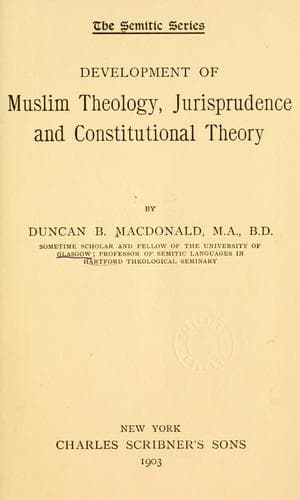
Development of Muslim Theology, Jurisprudence, and Constitutional TheoryMacDonald, Duncan Black
ReligionIslamic
Development of Muslim Theology, Jurisprudence, and Constitutional Theory
MacDonald, Duncan Black
Constitutional law (Islamic law); Islam -- Doctrines -- History; Islam and state -- History; Islamic law -- History
It is to the formation of these books of traditions, or, as we might
say, traditions in literature, that we must now turn. For long, the
fragmentary _sahifas_ and private collections made by separate scholars
for their own use sufficed. Books dealing with law (_fiqh_) were written
before there were any in that department of literature called _hadith_.
The cause of this is tolerably plain. Law and treatises of law were a
necessity for the public and thus were encouraged by the state. The
study of traditions, on the other hand, was less essential and of a more
personal and private nature. Further, under the dynasty of the Umayyads,
who reigned from A.H. 41 to A.H. 132, theological literature was little
encouraged. They were simple heathen in all but name, and belonged, and
recognized that they belonged, not to Islam but to the Jahiliya. For
reasons of state, they encouraged and spread—also freely forged and
encouraged others to forge—such traditions as were favorable to their
plans and to their rule generally. This was necessary if they were to
carry the body of the people with them. But they regarded themselves as
kings and not as the heads of the Muslim people. This same device has
been used after them by all the contending factions of Islam. Each party
has sought sanction for its views by representing them in traditions
from the Prophet, and the thing has gone so far that on almost every
disputed point there are absolutely conflicting prophetic utterances in
circulation. It has even been held, and with some justification, that the
entire body of _normative_ tradition at present in existence was forged
for a purpose. With this attitude of the Umayyads we shall have to deal
at greater length later. It is sufficient now to note that the first real
appearance of _hadith_ in literature was in the _Muwatta_ of Malik ibn
Anas who died in A.H. 179.
Yet even this appearance is not so much of _hadith_ for its own sake,
as of usages bearing upon law and of the law that can be drawn from
these usages. The book is a _corpus iuris_ not a _corpus traditionum_.
Its object was not so much to separate from the mass of traditions in
circulation those which could be regarded as sound of origin and to unite
them in a formal collection, as to build up a system of law based partly
on tradition. The previous works dealing with law proper had been of a
speculative character, had shown much subjective reliance on their own
opinion on the part of the writers and had drawn little from the sacred
usage of the Prophet and quoted few of his traditional sayings. Against
that the book of Malik was a protest and formed a link between such law
books pure and the collections of traditions pure with which we now come
to deal.
[Sidenote: THE MUSNADS]
Public-domain text, read in full here on John Shaqi.
Reviews
Reviews
No reviews yet
Be the first to share your thoughts on this work.
Elsewhere in the archive
Join the Discussion
Join the discussion
Sign in to leave a comment or review.
Sign InorCreate an account