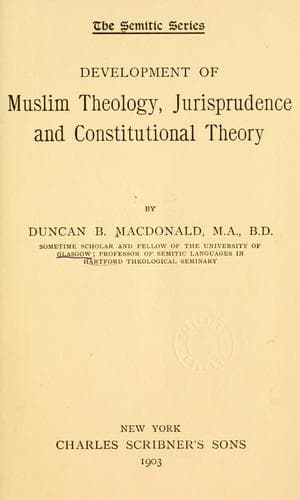
Development of Muslim Theology, Jurisprudence, and Constitutional TheoryMacDonald, Duncan Black
ReligionIslamic
Development of Muslim Theology, Jurisprudence, and Constitutional Theory
MacDonald, Duncan Black
Constitutional law (Islamic law); Islam -- Doctrines -- History; Islam and state -- History; Islamic law -- History
(_isnad_) over whose lips it had passed. A said, “There narrated to me
B, saying, ‘There narrated to me C, saying,’” so far the _isnad_, until
the last link came, and the _matn_, the Prophet of God said, “Some of my
injunctions abrogate others,” or “The Jann were created of a smokeless
flame,” or whatever it might be. What has just been said suggests that
it was at first indifferent whether traditions were preserved orally
or in writing. That is true of the first generation; but it must be
remembered at the same time, that the actual passing on was oral; the
writing merely aided the memory to hold that which was already learned.
But with time, and certainly by the middle of the second century of
the Hijra, two opposing tendencies in this respect had developed. Many
continued to put their trust in the written word, and even came to pass
traditions on without any oral communication. But for others there lay
grave dangers in this. One was evidently real. The unhappy character of
the Arabic script, especially when written without diacritical points,
often made it hard, if not practically impossible, to understand such
short, contextless texts as the traditions. A guide was necessary to show
how the word should be read, and how understood. At the present time a
European scholar will sometimes be helpless before even a fully vocalized
text, and must take refuge in native commentaries or in that oral
tradition, if it still exists and he has access to it, which supplies at
least a third of the meaning of an Arabic book. Strengthening this came
theological reasons. The words of the Prophet would be profaned if they
were in a book. Or, again, they would be too much honored and the Qur’an
itself might be neglected. This last fear has been justified to a certain
extent by the event. On these grounds, and many more, the writing and
transmitting in writing of traditions came to be fiercely opposed; and
the opposition continued, as a theological exercise, long after many
books of traditions were in existence, and after the oral transmission
had become the merest farce and had even frankly dropped out.
[Sidenote: TRADITIONS IN LITERATURE]
Public-domain text, read in full here on John Shaqi.
Reviews
Reviews
No reviews yet
Be the first to share your thoughts on this work.
Elsewhere in the archive
Join the Discussion
Join the discussion
Sign in to leave a comment or review.
Sign InorCreate an account