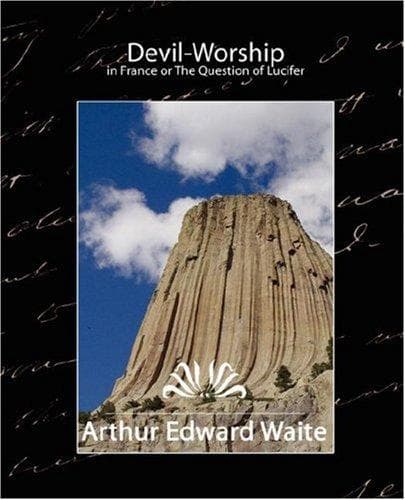
Devil-Worship in France; or, The Question of LuciferWaite, Arthur Edward
Religion
Devil-Worship in France; or, The Question of Lucifer
Waite, Arthur Edward
Satanism
The sorcery of the nineteenth century is under no circumstances likely
to justify the faggots of the fifteenth; it might be easier to justify
the sorcery. As much by mystics as by the Church Catholic, modern black
magic may be left to perish of its own corruption. But an attempt on the
part of the Church to fasten the charge of diabolism on the Masonic
Fraternity has credibly another motive than that of political hostility,
which seems held to justify almost any weapon that comes to hand. At the
bottom of her hatred of Masonry there is also her dread of the mystic.
Transcendental science claims to have the key of her doctrines, and
there is evidence that she fears that claim. Black magic, which, by the
hypothesis, is the use of the most evil forces for the most evil
purposes, she does not fear, for it wears its condemnation on its
forehead; but mysticism, which accepts her own dogmas and interprets
them in a sense which is not her own, which claims a certitude in
matters of religion that transcends the certitude of faith, seems to
hint that at one point it is possible to undermine her foundations.
Hence she has ever suspected the mystic, and a part of her suspicion of
Masonry has been by reason of its connection with the mystic; she has
intuitively divined that connection, which by Masons themselves, for the
most part, is not dreamed at this day, and when suggested is generally
somewhat lightly cast aside. It would be quite out of place at the
close of the present inquiry, which, from a wholly independent
standpoint, has sought to justify a great fraternity from a singularly
foul aspersion, to attempt enforcing upon Masons a special view of their
institution, but it is desirable, at the same time, to be just towards
the Catholic Church, and to affirm that we, as mystics, are on this
point substantially in agreement with her. The connection in question
was for a time visible, and remains in historical remembrance; from the
beginning of its public appearance till the close of the eighteenth
century, the history of Masonry is part of transcendental history. That
connection has now ceased to manifest, but there is another which is
integral and permanent, and is a matter of common principles and common
objects. Let it be remembered, however, that connection is not identity;
it is not intended to say that the threshold of Masonry is a gate of
Mysticism, but that there is a community of purpose, of symbolism, of
history, and indirectly of origin, between the two systems.
Public-domain text, read in full here on John Shaqi.
Reviews
Reviews
No reviews yet
Be the first to share your thoughts on this work.
Elsewhere in the archive
Join the Discussion
Join the discussion
Sign in to leave a comment or review.
Sign InorCreate an account