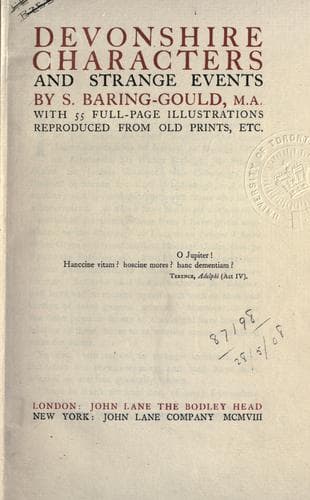
Devonshire Characters and Strange EventsBaring-Gould, S. (Sabine)
History
Devonshire Characters and Strange Events
Baring-Gould, S. (Sabine)
Devon (England) -- Biography; Devon (England) -- History
But now the despicable Charles II was king, and the power of England
to protect its subjects was sunk to impotence. Every three years the
English fleet appeared off Algiers to renew a treaty of peace with
the Dey, that meant nothing; the piratical expeditions continued, and
Englishmen were allowed to remain groaning in slavery, tortured into
acceptance of Mohammedanism, and not a finger was raised for their
protection and release. The Consuls were impotent. They could do
nothing. There was no firm Government behind them.
In Algiers, Pitts met with an Englishman, James Grey, of Weymouth, with
whom he became intimate. This man often appealed to Pitts for advice,
whether he should turn Mussulman or not; but Pitts would give him no
counsel one way or the other. Finally, he became a renegade, but moped,
lost all heart, and died.
Pitts tells us how that secretly he received a letter from his father,
advising him “to have a care and keep close to God, and to be sure,
never, by any methods of cruelty that could be used towards him, to
deny his blessed Saviour; and that he--his father--would rather hear
of his son’s death than of his becoming a Mahommedan.” The letter was
slipped into his hands a few days after he had become a renegade. He
dared to show this to his master, and told him frankly, “I am no Turk,
but a Christian.” The master answered, “If you say this again, I will
have a fire made, and burn you in it immediately.”
The then Dey, Baba Hasan, died in 1683, and Pitts’ master being rich
and having friends, attempted a revolt against Hasein “Mezzomorto,” his
successor, and was killed in the attempt. This led to the sale of Pitts
again, and he was bought by an old bachelor, named Eumer, a kindly old
man, with whom he was happy. “My Work with him was to look after his
House, to dress his Meat, to wash his Clothes; and, in short, to do all
those things that are look’d on as Servant-maids’ work in England.”
With the old master he made the pilgrimage to Mecca, and thence went
on to Medina, and he was the first Englishman to give a description of
these sacred towns. Moreover, his account is remarkably exact. He was a
young fellow full of observation and intelligence, and he made good use
of his eyes. At Mecca, Eumer gave Pitts his freedom, and Pitts remained
with him, not any longer as a slave, but as a servant.
By being granted his freedom this did not involve the liberty to return
to his home and his Christian religion. But he looked out anxiously
for an opportunity to do both. This came in a message arriving from
Constantinople from the Sultan to demand the assistance of Algerine
vessels, and Joseph Pitts volunteered as a seaman upon one of these
vessels, in the vain hope of its being captured by some Christian
vessel--French, for there was nothing to be expected from English ships.
Public-domain text, read in full here on John Shaqi.
Reviews
Reviews
No reviews yet
Be the first to share your thoughts on this work.
Elsewhere in the archive
Join the Discussion
Join the discussion
Sign in to leave a comment or review.
Sign InorCreate an account