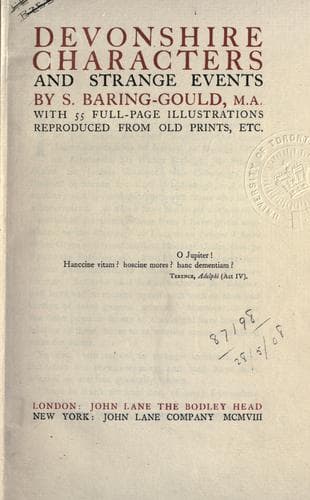
Devonshire Characters and Strange EventsBaring-Gould, S. (Sabine)
History
Devonshire Characters and Strange Events
Baring-Gould, S. (Sabine)
Devon (England) -- Biography; Devon (England) -- History
Sir William was probably born at Hankford, the ancient seat of the
family, in the hamlet of Bulkworthy, a chapel-of-ease to Buckland
Brewer. He was made Serjeant-at-law in 1391 in the reign of Richard
II, and was advanced to be one of the lords-justices in the Court of
Common Pleas in 1397. He was made Knight of the Bath at the coronation
of Henry IV, and, as already said, he was called up higher to be Chief
Justice by Henry V on his accession to the throne. He retained his
office for part of a year under Henry VI, so that he served under
four kings. He moved from Hankford, the family seat, to Annery, in
the parish of Monkleigh, near Great Torrington, a beautiful spot on
the Torridge. Here he had a stately mansion “famous for a large upper
gallery, wherein might be placed thirty standing beds, fifteen of a
side, and yet not one to be seen there. Nor could you from one bed
see another: for this gallery being very long and wainscotted on each
hand, there were several doors in it, which led into little alcoves or
apartments, well plaistered and whited, large and convenient enough for
private lodgings.”
Annery still stands in its beautiful park, but the gallery has
disappeared; it was pulled down in the year 1800.
Towards the end of his days Hankford fell into deep fits of depression
in retirement at Annery, where, weary of life and despondent at the
prospect of the new reign with an infant as king, and with furious
rivalries ready to break forth and tear the kingdom to pieces, he was
impatient that death might end his troubles.
“On a fit time for the purpose, he called to him the keeper of his
park, which adjoined his house at Annery, and charged him with
negligence in his office, suffering his deer to be killed and stolen;
whereupon he left it in strict charge with him, that he should be more
careful in his rounds by night, and that if he met any one in his
walk that would not stand and speak, he should shoot him, whoever he
was, and that he would discharge him (i.e. free him of blame). This
the keeper directly promised, and too faithfully performed. The judge
having thus laid the design, meaning to end his doleful days, in a
dark tempestuous night, fit for so black an action, secretly conveyed
himself out of the house, and walked alone in his park, just in the
keeper’s way; who being then in his round, hearing somebody coming
towards him, demanded, Who was there. No answer being made, he required
him to stand; the which when he refused to do, the keeper shot and
killed him upon the place: and coming to see who he was, found him to
be his master.”
Public-domain text, read in full here on John Shaqi.
Reviews
Reviews
No reviews yet
Be the first to share your thoughts on this work.
Elsewhere in the archive
Join the Discussion
Join the discussion
Sign in to leave a comment or review.
Sign InorCreate an account