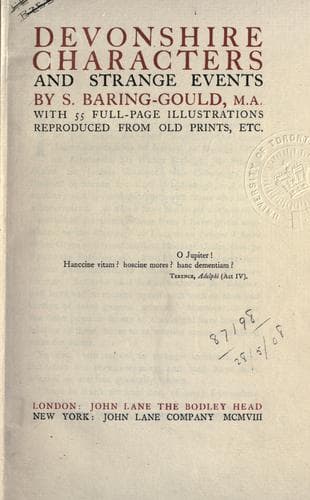
Devonshire Characters and Strange EventsBaring-Gould, S. (Sabine)
History
Devonshire Characters and Strange Events
Baring-Gould, S. (Sabine)
Devon (England) -- Biography; Devon (England) -- History
The authority for the story of Sir John Fitz’s death is _The Bloudie
Booke; or, the Tragical End of Sir John Fitz_. London, 1605. Probably
enough written by a chaplain to the Earl of Northumberland, then at
Sion House, who hearing of what had happened, sent this chaplain to
Twickenham, and to Sir John, at the “Anchor,” “To put him in mind what
he had done and persuade him to repent.”
LADY HOWARD
The Earl of Northumberland had shown himself solicitous for the welfare
of the soul of Sir John Fitz when he heard of the murder and suicide
at Twickenham; he was even more solicitous over his estate. He was
aware that Sir John had left an only daughter, still a child, who was
with her mother at Radford. He posted up to London at once, saw the
King, and bought of him the wardship of the little orphan for £465,
to be paid in instalments, and raised out of the estate of the little
heiress, who was then aged nine years and one week.
“The law of wardship,” says Mrs. G. Radford, “seems so cruel and
tyrannical that it is wonderful that it should have endured so long. By
it, when any man who held land _in capite_, or direct from the Crown,
died, his heir, if a minor, belonged to the king, who had a right to
receive all rents and profits from these lands until the heir became
of age. He could also marry the ward to whom he would. Henry VIII
established the Court of Wards and Liveries, the number of estates held
_in capite_ being so great that some organized system was necessary.
By it the wardship and marriage of minors were sold to the highest
bidder, who was sometimes the child’s mother or the executors of the
father’s will. But if they were not very prompt in applying, or did
not offer the largest sum, then to any stranger. The guardian would
have complete control over the ward, who generally lived in his
house, could marry the ward as he liked, this also being generally an
affair of money, and received the rents of the minor’s estate without
any liability to account.”[6]
[Illustration: LADY HOWARD]
Accordingly, at the age of nine, little Mary Fitz was taken from her
mother, but under whose charge she was placed at first does not appear.
A year or two later, she was living in the house of Lady Elizabeth
Hatton, second wife of Sir Edmund Coke, then Master of the Court of
Wards. At once the Earl of Northumberland sent his brother, Sir Allan
Percy, into Devon to look over the estates of Mary Fitz and make what
money he could out of them by felling timber.
Public-domain text, read in full here on John Shaqi.
Reviews
Reviews
No reviews yet
Be the first to share your thoughts on this work.
Elsewhere in the archive
Join the Discussion
Join the discussion
Sign in to leave a comment or review.
Sign InorCreate an account