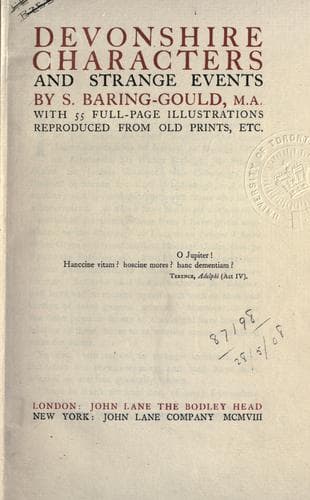
Devonshire Characters and Strange EventsBaring-Gould, S. (Sabine)
History
Devonshire Characters and Strange Events
Baring-Gould, S. (Sabine)
Devon (England) -- Biography; Devon (England) -- History
It was now charged against Mr. Germyn that “he preached that John
Baptist and Mary Magdalen wear married in a citie called Cana in
Galilee,” also that “the said Parson readeth the usuall divine prayers
soe fast that few can understand what he sayeth or the clarke can spare
to answere him accordinge to what is sett fourth in the booke of Common
prayer,” also that “he setteth out the Church yard for 8 shillings
and sixpence, and suffereth the horses and sheepe to use the Church
porche as a common folde, the smell being verie loathesome to the
Parishioners.”
Then came in an accusation of Peter Ebsworthy, “for usurpinge of place
in the Churche, being a man of no discent, or parentage, and claiminge
a Seate unfittinge for a man of his ranke or position.”
This was not a reasonable charge. The Ebsworthys, it is true, in
1620 could prove only three descents, but one had married an heiress
of Shilston, another an heiress of Durant, and they were allied by
marriage with the Calmadys, the Harrises, and the Ingletts. The
Ebsworthys, of Ebsworthy, had probably lived on their paternal acres as
long as had the Bidlakes, of Bidlake, but as yet they had laid no claim
to bear coat-armour. The Bidlakes bore two white doves, but naturalists
say that doves and pigeons are the most quarrelsome of birds.
The spiteful remark about Peter Ebsworthy being of no descent and
parentage was intended to wound the feelings of the rector, who had
married one of his daughters to Peter Ebsworthy. The ancients said that
doves were without gall.
“Next for his wief abusing of my wief in goinge to the Communion, by
blowes and afterwards with disgracefull words.” Also, “Paule Ebsworthy
for layinge of violent handes upon my wief in the Church yard: and his
wiefs scouldinge, Katheren Ebsworthy using these wordes before the
Parson unto her sister, Peter’s wief, that her sister might be ashamed
to suffer such to goe before her as my wief was.”
It seems that Agnes Bidlake, the wife of William, sought assistance
of her uncle, Sir Edward Giles, to bring these complaints before the
Bishop. He replied to this by writing to William Bidlake:--
“I would intreat you and my niece your wife at the time of hearinge of
these differences before his Lordshipp to be very temperate in your
utterances. You know it is an old sayinge, A good matter may be marred
in the handlinge; and I know if passion doe not overcome you all, it
will be to my Lord’s good likeinge.”
Mr. Bidlake went up about the matter and interviewed the Bishop, who
agreed to hear the case at Okehampton on the following Thursday.
The Bishop wrote to Parson Germyn: “Being credibly informed that Mr.
Bidlake and his wief were latlie by your sonne Peter Ebsworthy and his
wief verie disgracefully wronged at a Communion ... as alsoe for your
scandalous and indiscreete doctrine which you usually teach I may not
att any hande suffer,” he summoned him to appear before him at his
approaching visitation at Okehampton.
Public-domain text, read in full here on John Shaqi.
Reviews
Reviews
No reviews yet
Be the first to share your thoughts on this work.
Elsewhere in the archive
Join the Discussion
Join the discussion
Sign in to leave a comment or review.
Sign InorCreate an account