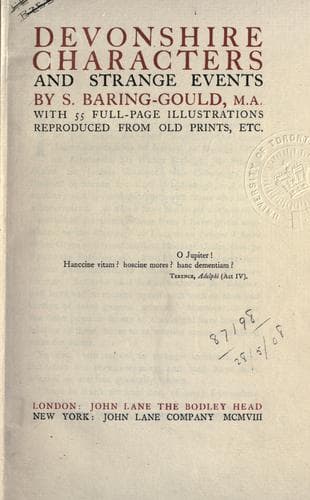
Devonshire Characters and Strange EventsBaring-Gould, S. (Sabine)
History
Devonshire Characters and Strange Events
Baring-Gould, S. (Sabine)
Devon (England) -- Biography; Devon (England) -- History
Nothing, however, came of this at the time, and the party that
perceived Stucley to be a charlatan grew stronger, his boasting palled,
and the King at last became suspicious and withdrew his favour.
Perceiving himself to be regarded on all sides with mistrust, not to
say with contempt, in a huff he left Spain, went to Italy, and offered
his service to the Pope. In 1571 he was given command of three galleys,
and partook in Don John’s victory over the Turks at Lepanto; and thus
raised himself considerably in King Philip’s estimation. Then he went
back to Rome, where “it is incredible how quickly he wrought himself
into the favour, through the Court into the Chamber, yea Closet, yea
Bosom of Pope Pius V; so that some wise men thought his Holiness did
forfeit a parcel of his Infallibility in giving credit to such a
_Glorioso_, vaunting that with three thousand Soldiers, he would beat
all the English out of Ireland.”
The Pope created Stucley Baron of Ross, Viscount Murrough, Earl of
Wexford, and Marquess of Leinster, and furnished him with a few vessels
and eight hundred soldiers, but these were to receive their pay from
the King of Spain.
Some contention arose as to the division of spoil when Elizabeth was
overthrown and England and Ireland were at the feet of Gregory XIII and
Philip of Spain. The Pope gave Stucley a consecrated banner to plant
in Ireland, which was to become wholly his own, and to which he was to
appoint the Pope’s bastard son, Giacomo Buoncompagni, as king.
Stucley left Civita Vecchia in March, 1577-8, but soon found that the
vessels were unseaworthy, and the military the offscouring of Italy.
Stucley put into Lisbon for repairs, and found King Sebastian of
Portugal preparing for his attempt on North Africa, having with him two
Moorish kings. The King persuaded Stucley to accompany him. Landing in
Africa, Stucley gave wise counsel to Sebastian not to engage the enemy
till the soldiers had recovered from the voyage, they having suffered
severely in the stormy passage. But the young King would listen to no
advice, and in the battle of Alcazar, on 4 August, 1578, Stucley lost
his life, regretted probably by none.
A fatal fight, where in one day was slain
Three king’s that were, and one that would be fain.
Thus perished a man of whom Cecil had written some years before,
“Thomas Stucley, a defamed person almost through all Christendom, and
a faithless beast rather than a man, fleeing first out of England for
notable piracies, and out of Ireland for treacheries unpardonable.”
Lord Burghley wrote: “Of this man might be written whole volumes to
paint out the life of a man in the highest degree of vain-glory,
prodigality, falsehood, and vile and filthy conversation of life, and
altogether without faith, conscience, or religion.”
Public-domain text, read in full here on John Shaqi.
Reviews
Reviews
No reviews yet
Be the first to share your thoughts on this work.
Elsewhere in the archive
Join the Discussion
Join the discussion
Sign in to leave a comment or review.
Sign InorCreate an account