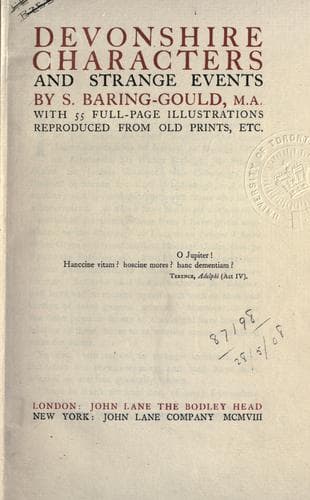
Devonshire Characters and Strange EventsBaring-Gould, S. (Sabine)
History
Devonshire Characters and Strange Events
Baring-Gould, S. (Sabine)
Devon (England) -- Biography; Devon (England) -- History
One day Sir Judas went to call on the old Earl of Nottingham, who
was Lord High Admiral, and asked to be allowed to speak to him. The
Earl turned on him instantly. “What,” he said, “thou base fellow! Thou
who art reputed the scorn and contempt of men, how darest thou offer
thyself into my presence? Were it not in my own house, I would cudgel
thee with my staff for presuming to be so saucy.” Stukeley ran off to
whine to the King, but even there he met with no redress. “What,” said
James, “wouldst thou have me do? Wouldst thou have me hang him? On my
soul, if I should hang all that speak ill of thee, all the trees in the
country would not suffice.” It was even said, probably without truth,
that James had said to Stukeley, “Sir Walter’s blood be on thy head.”
A few days after the scene with the King, it was discovered that
Stukeley had been for many years engaged in the nefarious occupation
of clipping coin. It was even said that he tampered in this way with
the very gold pieces which had been paid to him as the price of his
services for lodging Raleigh in the Tower and betraying him. When
arrested he endeavoured to excuse himself by inculpating his son. Could
meanness descend to a lower depth?
“1618-19. Jan. 12.... Upon Twelf night Stukely was committed close
prisoner in the Gate house for clipping of gould. He had receyved of
the Exchequer some weeks before £500 in recompense for the service he
had performed in the business of Syr Walter Raleigh, and beganne (as
is said) to exercise the trade upon that ill-gotten money (the price
of blood). Upon examination he endeavoured to avoid it from himself,
by casting the burden either upon his sonne or man. The former playes
least in sight and can not be found. The servant is committed to the
Marshalsay, who, understanding that his Master would shift over the
business to him, is willing to sett the saddle upon the right horse,
and accuses his Master.”[15]
But the accusation was not pressed. King James owed Stukeley too deep a
debt to let him suffer, and he threw him a pardon, so that the evidence
against him was not gone into. It may be remembered that “Lusty”
Stukeley had also been implicated in clipping and coining, and had only
escaped arrest by flying the country.
Stukeley, an outcast from society in London, went down to Affeton. But
even there he was ill-received. The gentry would not speak to him, his
own retainers viewed him with a cold, if not hostile, eye, and rendered
him but bare obedience.
The brand of Cain was on him, and he fled from the society of his
fellow men to the isle of Lundy, and shut himself up in the lonely,
haunted tower of the De Mariscoes. There he went raving mad and
perished (1620), a miserable lunatic on that rock, surrounded by
the roaring of the waves and the shrieks of the wind. His body was
conveyed to South Molton, so that he was denied even a grave beside his
ancestors at Affeton.
Public-domain text, read in full here on John Shaqi.
Reviews
Reviews
No reviews yet
Be the first to share your thoughts on this work.
Elsewhere in the archive
Join the Discussion
Join the discussion
Sign in to leave a comment or review.
Sign InorCreate an account