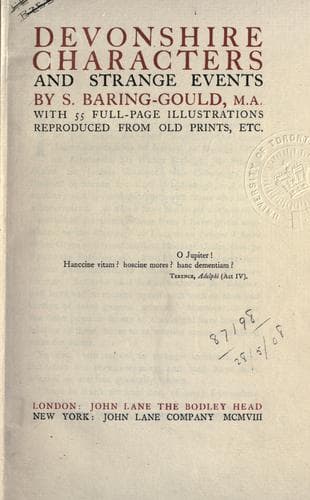
Devonshire Characters and Strange EventsBaring-Gould, S. (Sabine)
History
Devonshire Characters and Strange Events
Baring-Gould, S. (Sabine)
Devon (England) -- Biography; Devon (England) -- History
To this Mr. Colton promptly replied, that it was true that there was a
mop-stick in the house, but that by means of the mop-stick the sounds
heard and the vibration of the boards casting up dust could not have
been effected. He and others had tried, and the marks observed on the
ceiling were caused by these trials. As to the quarrel over a bill, it
had not occurred. It was not to Mr. Chave’s interest to give the house
a bad name, for he had but recently rented and fitted it up, and it
would be an inconvenience to him to move; moreover, these supernatural
phenomena were doing him much harm, in injuring his business.
Mr. Colton now added further mysterious sights, but they rested on
nothing better than the testimony of the maids. One had seen a white
hand come out from under the bed, another had seen a livid arm hanging
down from the ceiling.
There can, I think, be little doubt that it was not Mr. Chave, but
the servant-maids who managed the whole series of phenomena. These
knockings could easily be transmitted through boards, and the curtains
tossed about, and books and candlesticks flung across the room, by
having horsehair attached to them. That is the true secret of the
Poltergeist manifestations in England, France, and Germany.
The authorities are:--
“Sampford Ghost. A Plain and Authentic Narrative of those Extraordinary
Occurrences, etc., by the Rev. C. Colton, /M.A./, Reg. Col.
Soc., Tiverton” (1810).
“Sampford Ghost!!! A Full Account of the Conspiracy at Sampford
Peverell, near Tiverton; Containing the Particulars of the Pretended
Visitations of the Monster. Taunton, 1810.” (This by Marriott.)
“Sampford Ghost. Stubborn Facts against Vague Assertions, etc., by the
Rev. C. Colton, M.A., Reg. Col. Soc., Tiverton” (1810). Answer to Mr.
Marriott.
“Sampford Ghost! Facts Attested and Delivered to the Public Relative to
these Extraordinary Occurrences, etc., by the Rev. C. Colton.... London
(n.d.).”
PHILIPPA CARY AND ANNE EVANS
In the month of August, 1672, the wife of a dyer of Plymouth, one
William Weeks, died after “many and frequent vomitings.” Shortly
after that Mr. Weeks and his daughter were seized with the same
symptoms--violent pains internally, cold sweats, faintings and
vomitings; and in an engraving of the period relative to the tragic
event about to be related, Mr. Weeks is shown in bed affected by this
last symptom. At the outset the physician who attended them suspected
poison, and he was confirmed in his suspicions when a neighbour who had
entered the house found a pot in the kitchen with “crude arsenick” in
it. Moreover, Mr. Weeks’s grand-daughter, child of a Mistress Pengelly,
was affected in precisely the same manner.
Public-domain text, read in full here on John Shaqi.
Reviews
Reviews
No reviews yet
Be the first to share your thoughts on this work.
Elsewhere in the archive
Join the Discussion
Join the discussion
Sign in to leave a comment or review.
Sign InorCreate an account