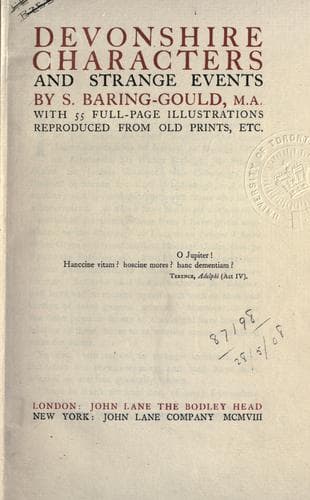
Devonshire Characters and Strange EventsBaring-Gould, S. (Sabine)
History
Devonshire Characters and Strange Events
Baring-Gould, S. (Sabine)
Devon (England) -- Biography; Devon (England) -- History
But the amount then administered was small: it was designed to cause
only preliminary discomfort. After that, Cary said, “We shall live
so merry as the days are long.” She cautioned the girl to hold her
tongue, and told her that if she did so nothing could come out; and she
threatened that if Evans betrayed what had been done, she would lay all
the blame upon her. In due time Mrs. Weeks asked for her porridge, and
the girl put the arsenic into the bowl according to the instructions
she had received from the nurse. Later on Cary drank from a jug; and
after pouring in the poisoned liquor, administered it to Mr. Weeks, but
he did not relish the taste of it and passed it on to the others to
try. They all averred that it had a “keamy” taste, but, small though
the quantity was that they drank, all who tasted it had convulsions.
In some concern at seeing her master and mistress in such anguish, the
girl affirmed that she had exclaimed, “Alas! nurse, what have you done
that our master and mistress are so very ill?”
Cary replied, according to Anne’s statement, that “she had done God
good service in it to rid her out of the way, and that she had done no
sin in it.”
This confession was read over to Cary, who denied every particular.
Cary and the little girl--who, be it remembered, was only twelve or
thirteen years of age--were put in prison, and were to appear at the
next assizes. Cary and Evans found themselves “in the very suburbs
of Hell,” for the local prison was no better than “a seminary of all
vilainies, prophaneness and impieties.”
After months of waiting, the prisoners were sent to Exeter, where they
were tried for their lives. They responded “with heavy hearts though
with undejected countenances.” Sentence of death was pronounced against
them both, but they petitioned to be transported.
The unfortunate little girl was sentenced “to be drawn on a hurdle to
the place where she shall be executed, and there burnt to death.”
John Quicke was a Nonconformist minister, and he interested himself
in the criminals. “Methinks,” said he, “the very sentence should have
struck her dead; an emblem and lively picture of Hell’s torments. Drawn
as if dragged by devils. Burnt alive, as if in the Lake of Fire and
Brimstone already.”
Public-domain text, read in full here on John Shaqi.
Reviews
Reviews
No reviews yet
Be the first to share your thoughts on this work.
Elsewhere in the archive
Join the Discussion
Join the discussion
Sign in to leave a comment or review.
Sign InorCreate an account