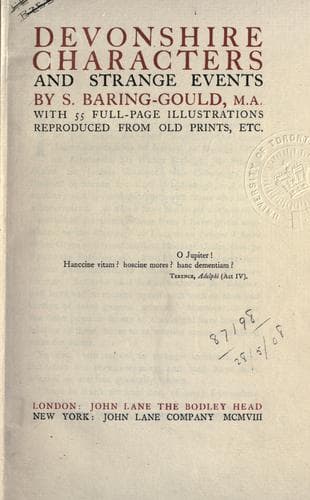
Devonshire Characters and Strange EventsBaring-Gould, S. (Sabine)
History
Devonshire Characters and Strange Events
Baring-Gould, S. (Sabine)
Devon (England) -- Biography; Devon (England) -- History
“There was a large cargo of ‘run’ goods being transported that
night--and you would have met it.”
“What of that?”
“What of that? You would have been chucked over the cliffs.”
“But how could they suppose I would peach?”
“Sir! They’d ha’ took good care you shouldn’t ha’ had the chance!”
The principal ports to which the smugglers ran were Cherbourg and
Roscoff; but also to the Channel Islands. During the European War, and
when Napoleon had formed, and forced on the humbled nations of Europe,
his great scheme for the exclusion of English goods from all ports,
our smugglers did a rare business in conveying prohibited English wares
to France and returning with smuggled spirits to our shores, reaping a
harvest both ways. If a revenue cutter hove in sight and gave chase,
they sank their kegs, but with a small buoy above to indicate where
they were, and afterwards they would return and “creep” for them with
grappling irons. But the preventive officers were on the alert, and
although they might find no contraband on the vessel they overhauled,
yet the officers threw out their irons and searched the sea in the wake
of the ship, and kept a sharp look-out for the buoys. If the contraband
articles were brought ashore, and there was no opportunity to remove
them at once, they were buried in the sand, to be exhumed when the
coast was clear.
The smugglers had more enemies to contend with than the preventive men.
As they were known to be daring and experienced sailors, they were in
great request to man the navy, and every crib and den was searched for
them that they might be impressed.
The life was hard, full of risks, and although these men sometimes
made great hauls, yet they as often lost their cargoes and their
vessels. They were very frequently in the pay of merchants in England,
who provided them with their ships and bailed them out when they
were arrested. Rarely did a smuggler realize a competence, he almost
invariably ended his days in poverty. One of the most notorious of the
Devon free-traders was Jack Rattenbury, who was commonly called “The
Rob-Roy of the West.” He wrote his _Memoirs_ when advanced in life,
and when he had given up smuggling, not that the trade had lost its
attraction for him, but because he suffered from gout, and he ended his
days as a contractor for blue-lias lime for the harbour in course of
erection at Sidmouth.
Public-domain text, read in full here on John Shaqi.
Reviews
Reviews
No reviews yet
Be the first to share your thoughts on this work.
Elsewhere in the archive
Join the Discussion
Join the discussion
Sign in to leave a comment or review.
Sign InorCreate an account