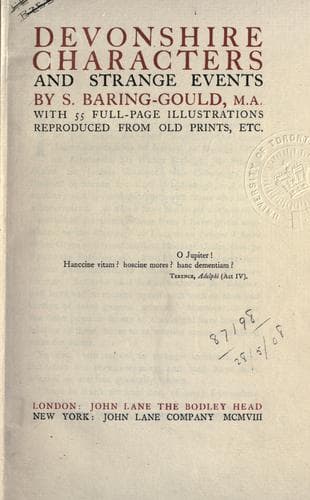
Devonshire Characters and Strange EventsBaring-Gould, S. (Sabine)
History
Devonshire Characters and Strange Events
Baring-Gould, S. (Sabine)
Devon (England) -- Biography; Devon (England) -- History
The “Black Horse” was an old inn near Southgate, Exeter. The south
gate was perhaps the strongest of all the gates. It was defended by
two massive drums of towers, and there was a double access to the
town through it, the first gate leading into a yard with a second
gate behind. Holy Trinity Church, with a red tower and pinnacles, was
close to the inner gate, and nigh by that swung the sign of the “Black
Horse.” The whole group was eminently picturesque. All was effaced in
1819; the gabled houses have been destroyed, not a stone left upon
another of the noble gateway; even Trinity Church was pulled down, and
a despicable cardboard edifice erected in its room as a specimen of the
utter degradation to which art had fallen at that period.
John Barnes was taverner at the “Black Horse” in and about the years
1670-5, during which he had three children christened in Trinity
Church. He kept his tavern well. His wife was reputed to be a quiet,
tidy, and respectable woman, and John Barnes professed to be a hot and
strong Presbyterian, and he made of his house a rallying-place of the
godly who were in a low way after the Restoration and the ejection
from their benefices of the ministers who had been intruded into them
during the days of the Commonwealth, when the Church pastors were
ejected. It was turn and turn about. These latter had been thrown out
of their nest by Independent and Presbyterian cuckoos, and now the
cuckoos had to go and the original owners of the nests were reinstated.
But the cuckoos did not like it, and the Puritans were very sore
afflicted, and liked to meet and grumble and testify, over ale and
cyder, in John Barnes’ tavern. And when a private prayer meeting was
held, mine host of the “Black Horse” was sure to be there, and to give
evidence of his piety by sighs and groans. But he testified against
prelacy more efficaciously than by upturned eyes and nasal whines, for
he refused to have his children baptized by the Church clergy, and was
accordingly prosecuted in the Exeter Consistory.
About 1677 Barnes abandoned the “Black Horse” in Exeter, and took an
inn at Collumpton, where he threw off the “religious mask” and ran
into debt and evil courses. One of his creditors was a smith, “a stout
fellow of good natural courage.”
Barnes could not or would not discharge the debt, and he suggested to
the blacksmith that there was an opening for doing a fine stroke of
business that would at once liquidate the little bill and make him a
man for ever. The plan was to waylay and rob the Exeter carrier on his
way up to London, charged with a considerable amount of money sent to
town by the merchants for the purchase of sundry goods. The blacksmith
agreed, but it was deemed prudent to have another confederate, so a
woolcomber was prevailed on to join.
Public-domain text, read in full here on John Shaqi.
Reviews
Reviews
No reviews yet
Be the first to share your thoughts on this work.
Elsewhere in the archive
Join the Discussion
Join the discussion
Sign in to leave a comment or review.
Sign InorCreate an account