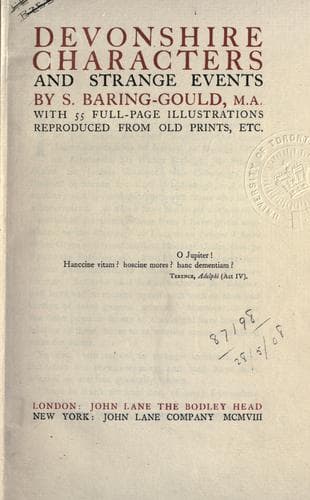
Devonshire Characters and Strange EventsBaring-Gould, S. (Sabine)
History
Devonshire Characters and Strange Events
Baring-Gould, S. (Sabine)
Devon (England) -- Biography; Devon (England) -- History
event stirred within him until he reached the cottage. Some of the best
of them would flit out of his memory, if he delayed to pen them as they
arose. So he ran with all his might and main for a third of a mile,
all panting with the race for time, found he had caught enough of it
for pencilling on his knee a whole verse of the song. Thus he ran and
wrote, each stanza costing him a race that made the hot perspiration
fall upon the soiled and crumpled paper, on which he brought home to a
wife prouder than himself of the song,--‘The Lion Flag of England.’”
GEORGE MEDYETT GOODRIDGE
The record of the adventures of this man is fully as interesting as the
fictitious story of _Robinson Crusoe_ and well deserves republication.
It was first published in Exeter in 1837. Two editions of a thousand
copies each were exhausted, and a third was published in 1839, and a
fourth in 1841.
George Medyett Goodridge was born at Paignton on 22 May, 1796. At
the age of thirteen he hired himself as cabin-boy on board the _Lord
Cochrane_, an armed brig, stationed off Torquay to protect the fishing
craft from French cruisers. From that time till 1820 he was continually
at sea; in that year, on 1 May, he joined the _Princess of Wales_,
a cutter, burthen seventy-five tons, bound for the South Seas after
oil, fins, seal-skins, and ambergris. The arrangement was that out of
every ninety skins procured, each mariner should have one; the boys
proportionately less; and the officers proportionately more. Captain
Veale was commander, Mazora, an Italian, mate; there were in addition
three boys and ten mariners.
In descending the Thames from Limehouse, a Captain Cox went on board
and made a present to the crew of a Bible. “We thought little of the
gift at the time,” says Goodridge, “but the sequel will show that this
proved to be the most valuable of all our stores.” In passing down the
Channel, the vessel was wind-bound for several days, and Goodridge was
able to visit his friends at Paignton, and bid them farewell. “On
the 21st, being Whit Sunday, the weather proved fine, with a breeze
from the northward, we again weighed anchor and proceeded on our
voyage.”
[Illustration: CHARLES MEDYETT GOODRIDGE IN HIS SEAL-SKIN DRESS]
On 2 November the vessel reached the Crozets, a group of five islands
in the South Pacific Ocean.
Public-domain text, read in full here on John Shaqi.
Reviews
Reviews
No reviews yet
Be the first to share your thoughts on this work.
Elsewhere in the archive
Join the Discussion
Join the discussion
Sign in to leave a comment or review.
Sign InorCreate an account