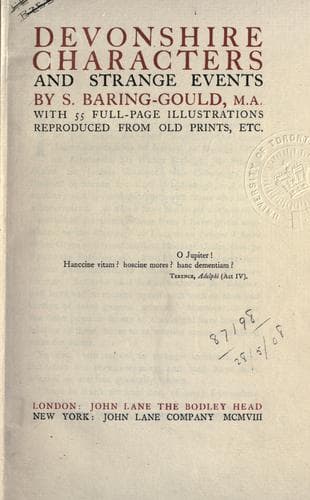
Devonshire Characters and Strange EventsBaring-Gould, S. (Sabine)
History
Devonshire Characters and Strange Events
Baring-Gould, S. (Sabine)
Devon (England) -- Biography; Devon (England) -- History
“The supply of seals we found very scanty; our principal dependence,
therefore, was on the sea-elephants, which, from their great tameness,
became an easy prey. They served us for meat, washing, lodging, firing,
grates, washing-tubs, and tobacco pipes. The parts we made use of for
food, were the heart, tongue, sweetbread, and the tender parts of the
skin; the snotters (a sort of fleshy skin which hangs over the nose)
and the flappers. These, after boiling a considerable time, formed a
jelly, and made, with the addition of some eggs, adding a pigeon or
two, or a sea-hen, very good soup. The blood served to wash with, as
it quickly removed either dirt or grease. When we had articles that
needed washing, and had killed an elephant, we used to turn the carcase
on its back, and the intestines being taken out, a quantity of blood
would flow into the cavity. In this we cleansed the articles, and then
rinsing them in the stream, they were washed as well as if we had been
provided with soap.
“The skins served us for roofing, and of them we also formed our shoes
or moccasins, and these we used to sew together with thongs formed from
the sinews. Their teeth we formed into the bowls of pipes, and to this
attached the leg bone of some water-fowl, and together it formed a good
apparatus. Having no tobacco, we used the dried grass that grew on the
island.
“Of sea-elephants’ blubber we made our fires, and their bones laid
across on some stones formed grates to lay the blubber on. Of a piece
of blubber also, with a piece of rope-yarn stuck in it, we formed our
lamps, and it produced a very good light. The largest elephants are
about 25 ft. long and 18 ft. round, and their blubber was frequently 7
in. thick and would yield a tun of oil. The brain of the animal, which
was almost as sweet as sugar, was frequently eaten by us raw. The only
kind of vegetable on the island, besides grass, was a plant resembling
a cabbage, but we found it so bitter that we could make no use of it.
“Mr. Veale had fortunately saved his watch uninjured, so we were able
to divide our time pretty regularly. We usually rose about 8 in the
morning, and took breakfast at 9 o’clock; after breakfast some of the
party would go catering for the day’s provisions, while the others
remained at home to fulfil the domestic offices. We dined generally
about 1 o’clock, and took tea about 5. For some months this latter
meal, as far as the beverage went, consisted of boiled water only, but
we afterwards manufactured what we named Mocoa as a substitute for tea,
and this consisted of raw eggs beat up in hot water. We supped about 7
or 8 o’clock, and generally retired to rest about 10.
Public-domain text, read in full here on John Shaqi.
Reviews
Reviews
No reviews yet
Be the first to share your thoughts on this work.
Elsewhere in the archive
Join the Discussion
Join the discussion
Sign in to leave a comment or review.
Sign InorCreate an account