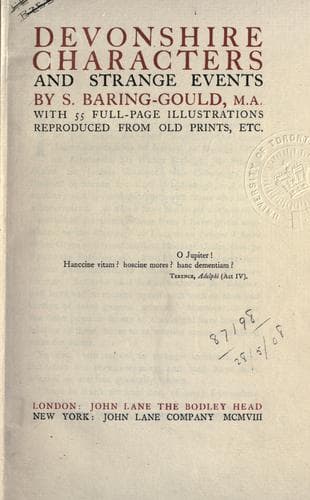
Devonshire Characters and Strange EventsBaring-Gould, S. (Sabine)
History
Devonshire Characters and Strange Events
Baring-Gould, S. (Sabine)
Devon (England) -- Biography; Devon (England) -- History
“Great numbers of birds visit these islands. There are three species of
Penguins beside the King Penguin, and these are named by South Sea men,
Macaroonys, Johnnys, and Rock Hoppers. The Macaroonys congregate in
their rookeries in great numbers, frequently three or four thousand;
they ascend very high up the hills, and form their nests roughly among
the rocks. They are larger than a duck, and lay three eggs, two about
the size of duck’s eggs, on which they sit; the other is smaller, and
is cast out of the nest, and we used to term it the pigeon’s egg, for
another kind of bird which frequent these islands, almost in every
respect resembling a pigeon, make their principal food of eggs, and
would rob the nests to procure them unless they found those cast-out
eggs, which most commonly satisfied them till the others by incubation
were unfit for food. A similar practice we observed with the Rock
Hoppers, but the Johnnys, like the King Penguins, lay only one egg
each, unless deprived of them.
“The Johnnys build their nests superior to either of the others among
the long grass. These birds lay in winter as well as in summer, and
by robbing their nests we kept them laying nearly all the year round.
We observed that when we robbed those which formed their nests on the
plain, that they rebuilt their nests higher up. When we took the eggs
of these birds, they would look at us most piteously, making a low,
moaning noise, as if in great distress at the deprivation, but would
exhibit no kind of resistance. The King Penguins, however, would strike
at us with their flippers, and their blows were frequently severe.
“The Rock Hoppers form their rookeries at the foot of high hills,
and make their nests of stones and turf. This is the only species of
Penguin that whistles; the King Penguins halloo, and the Johnnys and
Macaroonys make a sort of yawing noise.
“One kind of bird which proved very valuable to us are called Nellys.
They are larger than a goose, and resort to these islands in great
numbers. They make burrows in the ground, and were very easily caught.
These birds are so ravenous, that after we had killed a Sea-Elephant,
they would, in a few hours, completely carry off every particle of
flesh we did not make use of, leaving the bones clean as possible.
Their young became very good eating in March.”
Although this party knew that the other party of sealers had been left
on the larger island, they did not venture to cross to it, as the seas
were very rough, and winds were almost always contrary. However, this
party on the western island, in December, 1821, finding the seals very
scarce, and other provisions scanty, determined on visiting the eastern
island, but without the least expectation of finding any remnants of
the vessel, much less of meeting any of their comrades, whom they
supposed to be all drowned.
Public-domain text, read in full here on John Shaqi.
Reviews
Reviews
No reviews yet
Be the first to share your thoughts on this work.
Elsewhere in the archive
Join the Discussion
Join the discussion
Sign in to leave a comment or review.
Sign InorCreate an account