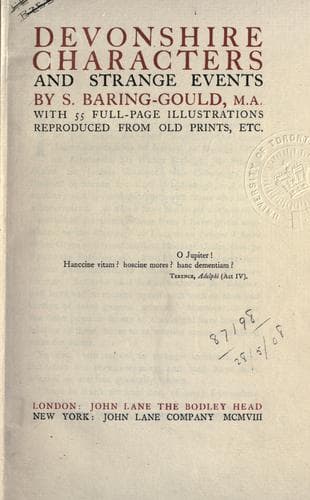
Devonshire Characters and Strange EventsBaring-Gould, S. (Sabine)
History
Devonshire Characters and Strange Events
Baring-Gould, S. (Sabine)
Devon (England) -- Biography; Devon (England) -- History
He was greatly lionized in Town, owing to the éclat attending his early
efforts, and was retained as composer of music by the managers of the
Theatres Royal until infirmities, rather than age, rendered him almost
incapable of exertion, unhappily a victim to drink. He died, before he
was sixty-two, in February, 1824, without a friend, and was buried in
St. Martin’s churchyard at the expense of two London tradesmen, one of
whom, Mr. Thomas, was a native of Crediton.
Davy at one time had an ambition to shine as an actor, and he actually
made his debut on the stage at Exeter, but failed.
Although Davy’s end was so wretched, many of his compositions will
never cease to be recollected and sung; notably that delicately
beautiful ballad, “Just Like Love”; others, more boisterous in
character, are, “May We Never Want a Friend,” “The Death of the
Smuggler,” and “The Bay of Biscay.”
For the life of Davy, see dictionaries of Musical Biography, and an
article by Dr. Edwards on “Crediton Musicians” in the _Transactions_ of
the Devonshire Association, 1882.
RICHARD PARKER, THE MUTINEER
For the story of Richard Parker, I shall quote almost verbatim the
account, which is very detailed, by Camden Pelham in _Chronicles of
Crime_, London, 1840.
In the year 1797, when the threatening aspect of affairs abroad made
the condition of the naval force a matter of vital importance to
Britain, several alarming mutinies broke out among the various fleets
stationed around the shores of the country. In April of the year
mentioned, the seamen of the grand fleet lying at Portsmouth disowned
the authority of their officers, seized upon the ships, hoisted the
red flag, and declared their determination not to lift an anchor, or
obey any orders whatsoever, until certain grievances of which they
complained were redressed.
There is no denying or concealing the fact--the men had been ill-paid,
ill-fed, shamefully neglected by the country, which depended upon them
for its all, and, in many instances, harshly and brutally treated by
their officers, and belly-pinched and plundered by their pursers. They
behaved with exemplary moderation. The mutineers allowed all frigates
with convoys to sail, in order not to injure the commerce of the
country. The delegates of the vessels drew up and signed a petition to
Parliament and another to the Admiralty; their language was respectful,
and their demands were very far from exorbitant.
Public-domain text, read in full here on John Shaqi.
Reviews
Reviews
No reviews yet
Be the first to share your thoughts on this work.
Elsewhere in the archive
Join the Discussion
Join the discussion
Sign in to leave a comment or review.
Sign InorCreate an account