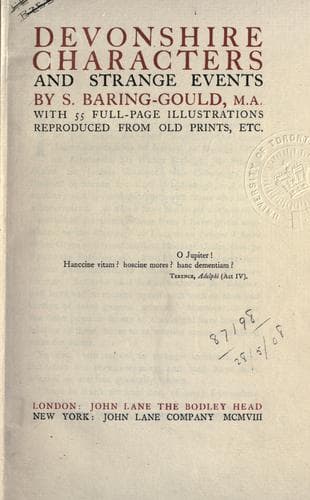
Devonshire Characters and Strange EventsBaring-Gould, S. (Sabine)
History
Devonshire Characters and Strange Events
Baring-Gould, S. (Sabine)
Devon (England) -- Biography; Devon (England) -- History
The two narratives are irreconcilable, and where the truth lies is
impossible to determine. It is conceivable that after van Broeck’s
visit--if it ever took place--Avery may have made his way to England
to dispose of his jewels, but we have no dates in the Dutchman’s
narrative, and no dates, and no authority quoted by Johnson for his
account of the last days of Avery. No reliance whatever can be placed
on Defoe’s _Life and Adventures of Captain John Avery_, “the King” in
Madagascar, 1720. Consequently the end of Avery remains, and probably
will remain, a mystery unsolved. Andrew Brice in his _Geographical
Dictionary_, published in 1759, under the heading of “Madagascar,”
says: “Pirates have had stations in these Harbours, among whom was
Avery, so much talked of 40 or 50 years ago.” Had Avery died at
Bideford, Brice as a Devonshire man would most likely have heard of it.
Salmon, in his _Universal Traveller_, 1759, says: “What became of Avery
himself I could never learn; but it is probable he is dead, or remains
concealed in the Island of Madagascar to this time; for he can expect
no Mercy from any of the Powers of Europe, if he should fall into their
hands, but as to being in such circumstances, as to lay the Foundation
of a New State or Kingdom in this Island, this report possibly deserves
little Credit. We should have heard more of him after so many years
elapsed, if he had made any figure there.”
According to Captain Johnson’s account, as we have seen, a Captain Wood
Rogers of the _Delicia_, a ship of forty guns, touched at Madagascar
with a design of purchasing slaves, and came on the settlement of the
crews of the two other vessels, but did not meet with Avery himself.
JOANNA SOUTHCOTT
The life of this impostor or self-deluded woman is not pleasant to
write or to read, and it is only because in such a collection including
Devonshire oddities and unworthies she could not be excluded that her
story is here given.
Joanna was a native of Gittisham, the daughter of William and Hannah
Southcott, respectable people, the father a very small farmer. She
was baptized at Ottery St. Mary, on 6 June, 1750. There was nothing
remarkable in her during the first forty years of her life. She was
in domestic service, and then moved to Exeter, where she entered the
household of an upholsterer, in 1790.
Public-domain text, read in full here on John Shaqi.
Reviews
Reviews
No reviews yet
Be the first to share your thoughts on this work.
Elsewhere in the archive
Join the Discussion
Join the discussion
Sign in to leave a comment or review.
Sign InorCreate an account