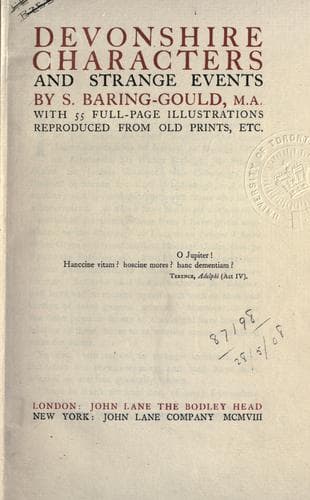
Devonshire Characters and Strange EventsBaring-Gould, S. (Sabine)
History
Devonshire Characters and Strange Events
Baring-Gould, S. (Sabine)
Devon (England) -- Biography; Devon (England) -- History
Here’s a pretty set of us
Nice young maidens.
Here’s a pretty set of us
All for husbands at a loss
But we cannot tarry thus,
Nice young maidens.
There is a Scottish version of the same, “Puir auld Maidens,” borrowed
from England.
Gay wrote:--
Sirs:--We, the maids of Exon-City,
The maids--good lack! the more’s the pity!
We humbly offer this petition
To represent our sad condition.
Which, once made known, our hope and trust is
Your honoured House will do us justice.
First you shall hear--but can’t you guess?--
The reason of our sad distress.
A maiden was designed by nature
A weakly and imperfect creature,
So liable to err and stray,
She wants a guide, requires a stay:
And then, so timorous of sprites,
She dreads to be alone at nights.
Say what she will, do what she can,
Her heart still gravitates to man.
As Mr. Chanter has pointed out, Gay has scarcely received due credit
for the number of proverbial couplets and sayings which have entwined
themselves in our daily language; for instance:--
When a lady’s in the case
You know all other things give place.
Those who in quarrels interpose,
Must often wipe a bloody nose.
Can Love be controll’d by advice?
While there’s Life there’s Hope.
If the heart of a man is depressed with cares,
The mist is dispelled when a woman appears.
The epitaph which Gay wrote for himself is a fit conclusion:--
Life is a jest, and all things show it;
I thought so once, but now--I know it.
BAMPFYLDE-MOORE CAREW
To _An Apology for the Life of Mr. Bampfylde-Moore Carew_, London,
n.d., but probably 1753, all the Lives of this disreputable man are
indebted. This was, in fact, his own autobiography, dictated by him
to some literary acquaintance, who put his adventures into shape and
padded them out with reflections and quotations from Shakespeare,
Horace, and mainly from Fielding’s _Tom Jones_.
The book has two dedications, the first is from the “Historiographer
to Mr. Bamfylde-Moore Carew” to Justice Fielding. The second is “To
the Public” from Bampfylde himself. The dedication to Henry Fielding
is by no means complimentary, and one strain of thought runs through
the whole _Apology_. It shows that Bampfylde-Moore Carew was not such
a scoundrel as was Tom Jones the hero of Fielding’s novel; and in that
attempt the author does not fail.
Public-domain text, read in full here on John Shaqi.
Reviews
Reviews
No reviews yet
Be the first to share your thoughts on this work.
Elsewhere in the archive
Join the Discussion
Join the discussion
Sign in to leave a comment or review.
Sign InorCreate an account