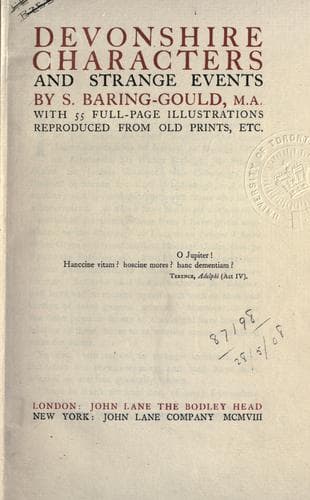
Devonshire Characters and Strange EventsBaring-Gould, S. (Sabine)
History
Devonshire Characters and Strange Events
Baring-Gould, S. (Sabine)
Devon (England) -- Biography; Devon (England) -- History
He, however, exchanged his disguise; for having heard that a vessel
containing many Quakers bound for Philadelphia had been cast away
on the coast of Ireland, he laid aside gown, cassock, and bands, and
assumed the garb and language and address of a Quaker. “His countenance
was now demure; the words You and Sir he seemed to hold in abomination;
his Hat was moved to none; for though under Misfortunes, he would
not think of bowing the knee to Baal.” Thus equipped he preyed very
successfully on the Friends. He even went to a great meeting of Quakers
from all parts at Thorncombe, in Dorset, and induced the Friends there
to make a considerable contribution for the relief of this member of
the sect who had fallen into such distress through the wreck.
His effrontery, his cunning, his utter unscrupulousness gained him such
credit among the gipsies that on the death of Claude Patch, who had
reigned previously over the canting crew, he was elected King of the
Beggars, and thenceforth drew from the whole community a certain income.
At last he was arrested, tried at the quarter sessions at Exeter, and
transported to Maryland, where he was sold to a planter. As he tried to
escape, an iron collar with a handle to it was riveted about his neck.
He again escaped; this time he succeeded in getting among the Indians,
who relieved him of his collar. He stole a canoe from his benefactors,
and in it made his way to Newcastle in Pennsylvania. There he wandered
about, pretending to be a Quaker, being everywhere well received by the
fraternity till he came to Derby, where Mr. Whitefield was preaching
and drawing crowds. He attended Whitefield’s meetings, pretended to be
a converted character, sought the preacher out, imposed on him, got
from him money, and departed for Philadelphia, and thence made his
way to New London, where resided two sisters of Sir John Davie, of
Creedy Park, near Crediton. They were married there, and their sons
were timber merchants. They were greatly delighted to see a man who
could inform them about their family, and he raised vain hopes in their
mind that “they were near heirs to a fine estate near Crediton.” So
completely were they taken in by him that they gave him money and a
letter to their relative Humphry Davie, recommending Carew to his good
offices. Carew embarked at New London for England. He was, however,
much afraid of being pressed for the Navy on approaching England. To
avoid this he pricked his breast and arms with a needle, rubbed in bay
salt and gunpowder, feigned to be very ill and to be light-headed.
It was suspected that he had small-pox, and as such, when an officer
came on board to see what men were there, he escaped. As ill with
small-pox, he was put ashore at Bristol, where he speedily threw off
all appearance of sickness, made the best of his way to a mumpers’
resort at Mile Hill, and had a carouse. He then made his way to Exeter,
where he fell in with the captain who had conveyed him to Maryland, and
Public-domain text, read in full here on John Shaqi.
Reviews
Reviews
No reviews yet
Be the first to share your thoughts on this work.
Elsewhere in the archive
Join the Discussion
Join the discussion
Sign in to leave a comment or review.
Sign InorCreate an account