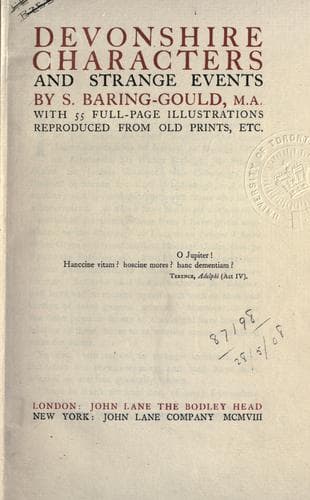
Devonshire Characters and Strange EventsBaring-Gould, S. (Sabine)
History
Devonshire Characters and Strange Events
Baring-Gould, S. (Sabine)
Devon (England) -- Biography; Devon (England) -- History
Hitherto he had not so much as dreamed of poetry, but his first attempt
was on the occasion of a person who had undertaken to paint a sign
for an inn; it was to have been a lion, but the artist had produced
a creature much more like a dog. One of his acquaintances wrote some
lines on it. Gifford looked them over, shook his head, and said that
he thought that he could do better. Accordingly he composed an epigram
on the theme, so cutting and droll that his shopmates declared he
had succeeded in a masterly manner. After that he ventured on other
attempts--doggerel, he says they were, but all caustic and humorous,
and these circulated, were laughed over, and gained him not a little
applause. When he had composed some brief little satire he would read
it to a select circle, and was rewarded by the gift of a few pence,
amounting occasionally to sixpence. Did he write also a few tender and
grateful lines to the pretty, smiling girl on the doorstep in the same
street, who had cheered the lonely boy? I have not the smallest doubt
in my mind that he did.
To one so long in absolute want of money, such a resource seemed
like a gold-mine, and although at this time he thought lightly, even
contemptuously of the Muse, and all his energies of mind were devoted
to mathematics, yet, as these trifles brought him in money, and so
enabled him to buy paper and ink, and books on geometry and algebra, he
continued to compose verses.
But a storm was gathering. There is a delightful picture by Phiz in
_David Copperfield_, where Mr. Creakle, the schoolmaster, enters the
schoolroom leaning on the arm of his factotum Tungay, just as a boy has
drawn a caricature of both on the blackboard.
Inevitably some of the keen shafts of Gifford’s ridicule had been
levelled at his master, the cobbler. This man laid himself open to
being satirized. He possessed a dictionary of synonyms; and it was
his practice never, when he could avoid it, to employ a direct word
when he could find a roundabout mode of expressing himself; a weeding
with him would be a _runcation_, and to ride would be to _equitate_.
It was not in human nature that William Gifford should withhold his
hand from turning out some neat lines taking off the sanctimonious and
pretentious cobbler, and so revenging himself for slights and insults
many. It is not in human nature that he should refrain from showing
this product to his fellow apprentices. It is not in human nature that
some sneak among them should not apprise the master or that master’s
son of what the sullen, discontented lad had done.
Public-domain text, read in full here on John Shaqi.
Reviews
Reviews
No reviews yet
Be the first to share your thoughts on this work.
Elsewhere in the archive
Join the Discussion
Join the discussion
Sign in to leave a comment or review.
Sign InorCreate an account